Great and Holy Thursday

Great and Holy Thursday

Commemorated on April 28
mysticalsupper02-s
Troparion — Tone 6

Of Your Mystical Supper, O Son of God, / Accept me today as a communicant. / For I will not speak of Your mysteries to Your enemies, / Neither like Judas will I give You a kiss, / But like the thief will I confess You. / Remember me, O Lord, in Your Kingdom!

Troparion — Tone 4

By Your precious blood, / You have redeemed us from the curse of the law. / By being nailed to the cross and pierced by a spear, / You have poured forth immortality for man. / O our Savior, glory to You!

Kontakion — Tone 8

Come, let us all sing the praises of Him who was crucified for us, / For Mary said when she beheld Him upon the tree: / Though You do endure the cross, You are my Son and my God!

Palm Sunday

The Entry of the Lord into Jerusalem (Palm Sunday)

11 / 24 April 2016

Extracts from the Vigil Service:

Palm SundayToday the grace of the Holy Spirit has gathered us together, and we all take up Thy Cross and say: Blessed is He that comes in the Name of the Lord; Hosanna in the highest.Today the Word and co-eternal Son of God the Father, whose throne is the heaven and whose footstool is the earth, humbles Himself and comes to Bethany, seated on a dumb beast, on a foal. Then the children of the Hebrews, holding branches in their hands, praise Him saying: ‘ Hosanna in the highest: blessed is He that comes, the King of Israel’.

Let us also come today, all the new Israel, the Church of the Gentiles, and let us cry with the Prophet Zechariah: Rejoice greatly, O daughter of Zion; shout aloud, O daughter of Jerusalem; for behold, thy King comes unto thee: He is meek and brings salvation, and He rides upon the colt of an ass, the foal of a beast of burden. Keep the feast with the children, and holding branches in your hands sing His praises: Hosanna to the highest; blessed is He that comes, the King of Israel.                                        

1st, 2nd 3rd Stichera of ‘Lord, I have cried

Tropar of The Entry of the Lord into Jerusalem, Tone 1: In confirming the common Resurrection, O Christ God, Thou didst raise up Lazarus from the dead before Thy Passion. Wherefore, we also, like the children bearing the symbols of victory, cry to Thee, O Vanquisher of death: Hosanna in the highest, blessed is He Who comes in the name of the Lord. Glory to the Father, and to the Son, and to the Holy Spirit,

Another Tropar of The Entry of the Lord into Jerusalem, Tone 4:  As by baptism we were buried with Thee, O Christ our God, so by Thy Resurrection we were deemed worthy of immortal life; and praising Thee, we cry: Hosanna in the highest; blessed is He that cometh in the name of the Lord. Both now and ever, and unto the ages of ages. Amen.

Kondak of The Entry of the Lord into Jerusalem, Tone 6: Being borne upon a throne in heaven, and upon a colt on the earth, O Christ God. Thou didst accept the praise of the angels and the laudation of the children as they cry to Thee: Blessed is he that cometh to  recall Adam.

5th Sunday of Great Lent

5th Sunday of Great Lent  St Mary of Egypt

4 / 17 April 2016

TSt. Mary of Egyptropar of St. Mary of Egypt, Tone 5:  Enlightened by the grace of the Cross, thou wast shown forth as a radiant lamp of repentance, dispelling the darkness of the passions, O all-holy one. Wherefore, thou didst appear as an angel in the flesh unto the sacred Zosimas in the wilderness. O Mary, our righteous mother, do thou intercede with Christ for us.

Kondak of St. Mary of Egypt, Tone 3: Thou who once of old wast filled with all manner of fornication, art now seen  today to be a bride of Christ by thy repentance. Thou didst love and emulate the life of the angels. By the Cross, thou didst annihilate the hordes of demons; for this cause thou art a bride now in the kingdom of the heavens, O Mary, thou all-modest one.

St. Mary of Egypt The recorder of the life of this wonderful saint was St Sophronius, Patriarch of Jerusalem. A hieromonk, the elder Zossima, had gone off at one time during the Great Fast a twenty-days’ walk into the wilderness across the Jordan. He suddenly caught sight of a human being with a withered and naked body and with hair as white as snow, who fled in its nakedness from Zossima’s sight. The elder ran a long way, until this figure stopped at a stream and called:’ Father Zossima, forgive me for the Lord’s sake. I cannot turn round to you, for I am a naked woman.’ Then Zossima threw her his outer cloak, and she wrapped herself in it and turned round to him. The elder was amazed at hearing his name from the lips of this unknown woman. After considerable pressure on his part, she told him her life-story.

She had been born in Egypt, and had lived as a prostitute in Alexandria from the age of twelve, spending seventeen years in this way of life. Urged by the lustful fire of the flesh, she one day got into a ship that was sailing for Jerusalem. Arriving at the Holy City, she tried to go into one of the churches to venerate the Precious Cross, but some unseen power prevented her from entering. In great fear, she turned to an icon of the Mother of God that was in the entrance, and begged her to let her go in and venerate the Cross, confessing her sin and impurity and promising that she would then go wherever the Most Pure led her. She was then allowed to enter the church. After venerating the Cross, she went out again to the entrance and, standing in front of the icon, thanked the Mother of God. Then she heard a voice: ‘If you cross the Jordan, you will find true peace.’ She immediately bought three loaves of bread and set off for the Jordan, arriving there the same evening. She received Communion the following morning in the monastery of St John, and then crossed the river. She spent forty-eight whole years in the wilderness in the greatest torments, in terror, in struggles with passionate thoughts like gigantic beasts. She fed only on plants. After that, when she was standing in prayer, Zossima saw her lifted up in the air. She begged him to bring her Communion the next year on the bank of the Jordan, and she would come to receive it.

The following year, Zossima came with the Holy Gifts to the bank of the Jordan in the evening, and stood in amazement as he saw her cross the river. He saw her coming in the moonlight and, arriving on the further bank, make the sign of the Cross over the river. She then walked across it as though it were dry land. When she had received Communion, she begged him to come again the following year to the same stream by which they had first met.

Zossima went, and found her dead body there on that spot. Above her head in the sand was written: ‘Abba Zossima, bury in this place the body of the humble Mary. Give dust to dust. I passed away on April 1st, on the very night of Christ’s Passion, after communion of the divine Mysteries.’ Zossima learned her name for the first time, and also the awe-inspiring marvel that she had arrived at that stream the previous year on the night of the same day on which she had received Communion—a place that he had taken twenty days to reach. And thus Zossima buried the body of the wonderful saint, Mary of Egypt.

When he returned to the monastery, he recounted the whole story of her life and the wonders to which he had been an eyewitness. Thus the Lord glorifies repentant sinners. St Mary is also commemorated in the Fifth Week of the Great Fast. The Church holds her up before the faithful in these days of the Fast as a model of repentance. She entered into rest in about 530.

The Fourth Sunday of Great Lent

4th Sunday of Great Lent  St John of the Ladder 28 March / 10 April 2016

st_john_ledderTropar of St. John Climacus, Tone 3: Having raised up a sacred ladder by thy words/ thou wast shown forth to all as a teacher of monastics/ and thou dost lead us, O John/ from the purification that cometh through godly discipline/ unto the light of Divine vision/ O righteous father/ do thou entreat Christ God// that we be granted great mercy.

Kondak of St. John Climacus, Tone 1: Offering teachings from thy book as ever-blossoming  fruits,  O wise one, thou dost sweeten the heart of them  that attend to them with vigilance, O blessed one; for it is a ladder that, from earth unto the heavenly and abiding glory, doth lead the souls of those who with faith do honour thee.

Our Holy Father John Climacus (of the Ladder)

The author of the famous ‘Ladder’, he came from an unknown place to Mount Sinai as a sixteen-year-old  boy and remained there, first as a novice, then as a hermit and finally as abbot of Sinai, until he died at the age of eighty, in about 649. His biographer, the monk Daniel, says of him: ‘He brought his body up to Mount Sinai, but his spirit he brought to the Mount of Heaven’. He spent nineteen years in obedience to his spiritual father, Martyrios. Anastasius of Mount Sinai, who saw John once as a young man, foretold that he would be abbot of Mount Sinai. After the death of his spiritual father, John took himself off to a cave, where he lived for twenty years in strict asceticism. His disciple, Moses, fell asleep one day in the cool shade of a huge rock. John was at prayer in his cell, and, perceiving that his disciple was in danger, began to pray for him. Moses came up to him later, fell to his knees and began to thank him for saving him from certain death. And he related how he had heard John calling him in his sleep and had jumped up at the very moment that a rock fell. Had he not jumped out of the way, the rock would certainly have killed him. At the importunate urging of the brethren, John accepted the abbacy, and guided their souls to salvation with loving zeal. He once heard a monk reproach him for being too verbose. He was not in the least angered, but was silent for an entire year, not uttering a single word until the brethren begged him to speak. He then began to instruct them with the wisdom with which God had endowed him. Once 600 pilgrims came to Mount Sinai. At supper they all noticed an agile young man dressed as a Jew who was serving at table and giving orders to the other servants, taking charge of everything. Suddenly, he disappeared. While everyone was pondering this and asking questions among themselves, John said: ‘Do not bother to look for him; that was the prophet Moses serving you in his own home.’ During the time that he was silent in his cave, John wrote many instructive books, of which the most famous, ‘The Ladder’, is much read to this day. It describes the way to raise the soul to God as if on a ladder. Before his death, John appointed his own brother, George, to the abbacy, but George began to grieve greatly at the approaching parting with John. Then John said that, if he were found worthy to stand close to God in the next world, he would pray that George be taken up to heaven in the same year. And so it came to pass. After ten months, George also fell asleep and departed to take his place among heaven’s citizens alongside his brother John.

The Annunciation

25 March / 7 April — The Annunciation of Our Most Holy Lady, the Theotokos and Ever-Virgin Mary —

annunciation

Troparion — Tone 4

Today is the beginning of our salvation, / The revelation of the eternal mystery! / The Son of God becomes the Son of the Virgin / As Gabriel announces the coming of Grace. / Together with him let us cry to the Theotokos: / Rejoice, O Full of Grace, / The Lord is with You!

Kontakion — Tone 8

O Victorious Leader of Triumphant Hosts! / We, your servants, delivered from evil, sing our grateful thanks to you, O Theotokos! / As you possess invincible might, set us free from every calamity / So that we may sing: Rejoice, O unwedded Bride!

When the most holy Virgin had lived and served in the Temple at Jerusalem for eleven years, and was by then fourteen years old— when, that is, she was entering on her fifteenth year—the priests informed her that, according to the Law, she could no longer remain in the Temple but must be betrothed and marry. But, to the great surprise of all the priests, the most holy Virgin replied that she had dedicated herself to God and wished to a maiden remain till death and enter into wedlock with no-one. Then, by God’s providence and under His inspiration, Zacharias, the high priest and father of the Forerunner, in consultation with the other priests, chose twelve unmarried men from the tribe of David so that they might entrust the Virgin Mary to one of them to preserve her virginity and care for her. She was thus entrusted to Joseph, an old man from Nazareth and a kinsman of hers. In his house, the most holy Virgin continued to live in the same manner as in the Temple of Solomon, passing her time in the reading of the sacred Scriptures, in prayer, in pondering on the works of God, in fasting and in handwork. She scarcely ever left the house, nor took an interest in worldly matters or events. She generally conversed very little with anyone, and never without a particular need. She was close friends only with the two daughters of Joseph. But when the time prophesied by the Prophet Daniel had come and when God was pleased to fulfil the promise made to Adam when He drove him out of Paradise, and to the prophets, the mighty Archangel Gabriel appeared in the chamber of the most holy Virgin, at the precise moment (as some priestly writers have related) that she was holding open on her lap the book of the Prophet Isaiah and pondering on his great prophecy: ‘Behold, a virgin shall conceive and bear a son’. Gabriel appeared to her in angelic light and said to her: ‘Rejoice, thou that art highly favoured, the Lord is with thee!’, and so forth, just as is related in the Gospel of the divine Luke. With this angelic greeting and the descent of the Holy Spirit, the salvation of mankind and the renewal of creation were set in motion. The Archangel turned the first page of the story of the New Testament with the word ‘Rejoice!’, to show by this the joy that the New Testament signifies for mankind and for all things created. And therefore the Annunciation is looked upon as a joyous, as well as a great, feast;

The Third Sunday of Great Lent

3rd Sunday of Great Lent  Veneration of the Holy Cross 21 March / 3 April 2016
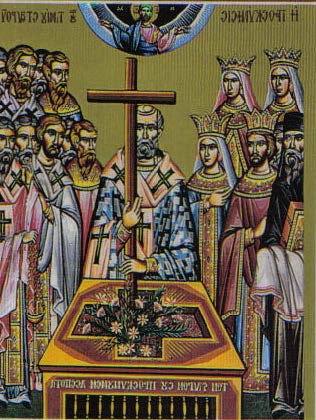
Veneration of the Holy CrossTropar of the Holy Cross, Tone 1: Save O Lord Thy people and bless Thine inheritance / Granting unto Orthodox Christians victory over their enemies / and by the power of Thy cross / preserving Thy community.

Kondak of the Holy Cross, Tone 4: O Thou Who wast lifted up willingly on the Cross, bestow Thy mercies upon the new community named after Thee, O Christ God: gladden with Thy power the Orthodox Christians, granting them victory over enemies; may they have as Thy help the weapon of peace, the invincible trophy.


THE CROSS PRESERVES THE UNIVERSE

In the Prophet Ezekiel (9:6), it is said that when the Angel of the Lord was sent to punish and destroy the sinning people, it was told him not to strike those on whom the “mark” had been made. In the original text this mark is called “tau,” the Hebrew letter corresponding to the letter “T,” which is how in ancient times the cross was made, which then was an instrument of punishment.

So, even then, it was foretold the power of the Cross, which preserves those who venerate it. Likewise, by many other events in the Old Testament the power of the Cross was indicated. Moses, who held his arms raised in the form of a cross during the battle, gave victory to the Israelites over the Amalekites. He also, dividing the Red Sea by a blow of his rod and by a transverse blow uniting the waters again, saved Israel from Pharaoh, who drowned in the water, while Israel crossed over on the dry bottom (Exodus, ch. 14, 17).

Through the laying on of his hands in the form of a cross on his grandsons, Jacob gave a blessing to his descendents, foretelling at the same time their future until the coming of the “expectation of the nations” (Genesis, ch. 48).

By the Cross, the Son of God, having become man and accomplished our salvation. He humbled Himself and became obedient unto death, even death on the Cross (Phil. 2:8). Having stretched out His hands upon the Cross, the Savior with them as it were embraced the world, and by His blood shed on it, like a king with red ink, He signed the forgiveness of the human race.

The Cross of the Lord was the instrument by which He saved the world after the fall into sin. Through the Cross, He descended with His soul into hell, to raise up from it the souls who were awaiting Him. By the Cross Christ opened the doors of paradise which had been closed after our first ancestors had been banished from it. The Cross was sanctified by the Body of Christ which was nailed to it when He gave Himself over to torments and death for the salvation of the world. Then it was

filled with life-giving power. By the Cross on Golgotha the prince of this world was cast out (John 12:31) and an end was put to his authority. The weapon by which he was crushed became the sign of Christ’s victory.

The demonic hosts tremble when they see the Cross, because the kingdom of hell was destroyed by the Cross. They do not dare to draw near to anyone who is guarded by the Cross.

The whole human race, by the death of Christ on the Cross, received deliverance from the authority of the devil, and everyone who makes use of this saving weapon is inaccessible to the demons.

When legions of demons appeared to St. Anthony the Great and other desert-dwellers,  they guarded themselves with the sign of the Cross, and the demons vanished.

When there appeared to St. Symeon the Stylite, who was standing on his pillar, what seemed to be a chariot to carry him to heaven, the Saint, before mounting it, crossed himself and it disappeared. The enemy, who had hoped to cast down the ascetic from the height of his pillar, was put to shame.

One cannot enumerate all the various incidents of the manifestation of the power of the Cross. Invisibly and unceasingly, Divine grace that gushes from it saves the world.

The sign of the Cross is made at all the Mysteries and prayers of the Church. With the making of the sign of the Cross over the bread and wine, they become the Body and Blood of Christ. With the immersion of the Cross the waters are sanctified. The sign of the Cross looses us from sins. “When we are guarded by the Cross, we oppose the enemy, without fearing his nets and barking.” Just as the flaming sword in the hands of the Cherubim barred the entrance into paradise of old, so the Cross now acts invisibly in the world, guarding it from perdition.

The Cross is the unconquerable weapon of pious kings in the battle with enemies. Through the apparition of the Cross in the sky, the dominion of Emperor Constantine was confirmed and an end was put to the persecution against the Church.

The apparition of the Cross in the sky in Jerusalem in the days of Constantius the Arian proclaimed the victory of Orthodoxy. By the power of the Cross of the Lord, Christian kings will continue to reign until Antichrist, barring his path to power and restraining lawlessness (St. John Chrysostom, Commentary on II Thes. 2:6-7).

The “sign of the Son of Man” (Matt. 24:30), that is, the Cross, will appear in the sky in order to proclaim the end of the present world and the coming of the eternal Kingdom of the Son of God. Then all the tribes of the earth shall weep, because they loved the present age and its lusts, but all who have endured persecution for righteousness and called on the name of the Lord shall rejoice and be glad. The Cross then will save all who conquered temptations, from eternal perdition by the Cross, who crucified their flesh with its passions and lusts, and took up their cross and followed afar Christ.

However, those who hated the Cross of the Lord and did not engrave the Cross in their soul will perish forever. For “the Cross is the preserver of the whole universe, the Cross is the beauty of the Church, the Cross is the might of kings, the Cross is the confirmation of the faithful, the Cross is the glory of angels and the scourge of demons” (Octoechos: Exapostilarion, Monday Matins).

St John of Shanghai and San Francisco – Shanghai, Exaltation of the Cross, 1947

The Second Sunday of Great Lent

The Second Sunday of Great Lent,  St Gregory Palamas, Archbishop of Thessalonica

14 / 27 March 2016

gregory_palamaTropar of St. Gregory Palamas, Tone 8:  Light of Orthodoxy, pillar and teacher of the Church, adornment of monastics, invincible champion of theologians, O Gregory thou wonderworker, boast of Thessalonica, herald of grace, ever pray that our souls be saved.

Kontakion of St Gregory Palamas, Tone 8:  O sacred and divine instrument of wisdom, joyful trumpet of theology / with one accord we sing thy praises, O Gregory inspired by God. / But since thou standest now in mind and spirit before the Original Mind // guide our minds to Him, O father, that we may cry to thee Hail, preacher of grace.

Kontakion from  the Triodion, Tone 4:  The season of the virtues hath now been revealed / and judgement is at the doors / therefore let us arise and keep the Fast / offering tears of compunction together with our alms / and let us cry: our sins are more than the sands of the sea / but do Thou pardon us, O Creator of all // that we may receive incorruptible crowns.

St. Gregory Palamas

Gregory’s father was an eminent official at the court of the Emperor Andronicus II Palaeologus. The gifted Gregory, completing his secular studies, did not want to go into imperial service at court, but withdrew to the Holy Mountain and became a monk, living in asceticism at Vatopedi and the Great Lavra. He waged war against the heretic Barlaam, and finally overcame him. He was consecrated Metropolitan of Salonica in 1347, being glorified both as an ascetic and a theologian, both as a hierarch and a wonderworker.. He was the defender of the Hesychasts. He upheld the doctrine that the human body played an important part in prayer, and he argued that the Hesychasts did indeed experience the Divine and Uncreated Light of Tabor. To explain how this was possible, St. Gregory developed the distinction between the essence and the energies of God. He set Hesychasm on a firm dogmatic basis, by integrating it into Orthodox theology, and by showing how the Hesychast vision of Divine Light in no way undermined the doctrine that God can not be comprehended. His teachings were confirmed by the local councils held in Constantinople in 1341 and 1351. St. Gregory began by reaffirming the Biblical doctrine of man and of the Incarnation; i.e. the whole man, united in body and soul, was created in the image of God, and Christ, by taking a human body at the Incarnation, has ‘made the flesh an inexhaustible source of sanctification’. The Hesychasts, so he argued, in placing emphasis on the body’s part in prayer, are not guilty of a gross materialism but are simply remaining faithful to the Biblical doctrine of man as a unity. Christ took human flesh and saved the whole man; therefore it is the whole man that prays to God. How is it possible for man to know God and, at the same time, affirm that God is by nature unknowable? St. Gregory answered this question by quoting St. Basil the Great who said “We know our God from His energies, but we do not claim that we can draw near to His essence. For His energies come down to us, but His essence remains unapproachable”. St. Gregory added “God is not a nature, for He is above all beings…. No single thing of all that is created has or ever will have even the slightest communion with the supreme nature, or nearness to it”. Even though God’s essence may be remote from us, He has revealed Himself through His energies (or grace). These energies do not exist apart from God, but are God Himself in His action and revelation to the world. It is through these energies that God enters into a direct and immediate relationship with us. When we say that the saints are ‘deified’ by the grace of God, we mean that they have a direct experience of God Himself through his energies (or grace), not in His essence. The vision of Light that Hesychasts receive is the same Light that surrounded Christ on Mount Tabor. It is a true vision of God in His divine energies.

The First Sunday of Great Lent

The First Sunday of Great Lent,  The Sunday of Orthodoxy 7 / 20 March 2016

Sunday of OrthodoxyThe First Sunday of Great Lent, Troparion, Tone II : We worship Thy immaculate Image, O Good One, and ask forgiveness of our sins, O Christ God; for of Thy own will Thou wast pleased to ascend the Cross in the flesh, to deliver from slavery to the enemy those whom Thou hadst created. Therefore we thankfully cry to Thee: Thou hast filled all things with joy, O our Saviour, by coming to save the world.

Kondak First Sunday of Great Lent, Tone 8: The Uncircumscribable  Word of the Father was circumscribed when he took flesh of thee, O Theotokos; and when He had restored the defiled image to its ancient state, He suffused it with divine beauty. As for us, confessing our salvation, we record it in deed and word.

Sunday of Orthodoxy

On this day the Church commemorates  the final ending of the Iconoclast controversy and the definitive restoration of the holy icons to the churches by the Empress Theodora, acting as Regent for her young son Michael III. This took place on the first Sunday in Lent, 11 March 843. There is, however, not only an historical link between the first Sunday and the restoration of the icons but also a spiritual affinity. If Orthodoxy triumphed in the epoch of the Iconoclast controversy, this was because so many of the faithful were prepared to undergo exile, torture, and even death, for the sake of the truth. The Feast of Orthodoxy is above all a celebration in honour of the martyrs and confessors who struggled and suffered for the faith: hence its appropriateness  for the season of Lent, when we are striving to imitate the martyrs by means of our ascetic self-denial. The fixing of the Triumph of Orthodoxy on the first Sunday is therefore much more than the result of some chance historical conjunction.

The Triodion gives the text of a special ‘Office of the Triumph of Orthodoxy’, which is held at the end of Matins or, more commonly, at the end of the Divine Liturgy on this Sunday. The Office celebrates not only the restoration of the holy icons but, more generally, the victory of the true faith over all heresies and errors. A procession is made with the holy icons, and after this extracts are read from the synodical decree of the Seventh Ecumenical Council (787). Then sixty anathemas are pronounced against various heretics dating from the third to the fourteenth century; ‘Eternal Memory’ is sung in honour of the emperors, patriarchs and fathers who defended the Orthodox faith; and ‘Many Years’ is proclaimed in honour of our present rulers and bishops. Unfortunately in many parts of the Orthodox Church today this impressive service has fallen into disuse; elsewhere it is performed in a greatly abbreviated form. Before the Triumph of Orthodoxy came to be celebrated on the first Sunday, there was on this day a commemoration  of Moses, Aaron, Samuel, and the prophets. Traces of this more ancient observance can still be seen in the choice of Epistle reading at the Liturgy (Hebrews 11: 24-6, 32-40), and in the Alleluia verse appointed before the Gospel: ‘Moses and Aaron among His priests, and Samuel among them that call upon His Name’.

Prayer of Saint Ephrem

Lenten Prayer of St. Ephrem


O Lord and Master of my life, take from me the spirit of sloth, despair, lust of power, and idle talk.
But give rather the spirit of chastity, humility, patience, and love to Thy servant.
Yea, O Lord and King, grant me to see my own transgressions, and not to judge my brother, for blessed art Thou, unto ages of ages. Amen.


https://oca.org/orthodoxy/prayers/lenten-prayer-of-st.-ephrem

Forgiveness Sunday

Forgiveness Sunday / Commemoration of the exile of Adam from Paradise 29 February / 13 March 2016

Adam ExcileThe Sunday of Forgiveness is the last Sunday prior to the commencement  of Great Lent. During the pre-Lenten period, the services of the Church include hymns from the Triodion, a liturgical book that contains the services from the Sunday of the Publican and the Pharisee, the tenth before Pascha , through Great and Holy Saturday. On the Sunday of Forgiveness focus is placed on the exile of

Adam and Eve from the Garden of Eden, and event that shows us how far we have fallen in sin and separated ourselves from God. At the onset of Great Lent and a period of intense fasting, this Sunday reminds us of our need for God’s forgiveness and guides our hearts, minds, and spiritual efforts on returning to Him in repentance.

Kondak to Cheese-fare Sunday, Tone 6:  O Thou guide unto wisdom, bestower of prudence, instructor of the foolish and defender of the poor: Establish and grant understanding unto my heart, O Master. Grant me speech, O Word of the Father; for behold, I shall not keep my lips from crying unto Thee: O Merciful One, have mercy on me who have fallen.

The Gospel According To St. Matthew 6: 14 –21 

14 The Lord said:  if ye forgive men their trespasses, your heavenly Father will also forgive you. 15 But if ye forgive not men their trespasses, neither will your Father forgive your trespasses. 16 Moreover, when ye fast, be not, as the hypocrites, of a sad countenance: for they disfigure their faces, that they may appear unto men to fast. Verily, I say unto you, They have their reward. 17 But thou, when thou fastest, anoint thine head, and wash thy face, 18 That thou appear not unto men to fast, but unto thy Father, which is in secret: and thy Father which seeth in secret shall reward thee openly. 19 Lay not up for yourselves treasures upon earth, where moth and rust doth corrupt, and where thieves break through and steal: 20 But lay up for yourselves treasures in heaven, where neither moth nor rust doth corrupt, and where thieves do not break through and steal. 21 For where your treasure is, there will your heart be also.


FORGIVENESS SUNDAY

This is the very beginning of Great Lent. For whatever we begin in life, we always compose some kind of plan of action, a program of what we have to accomplish and in what order. But here we don’t have to do this; today’s Gospel gives us this program. Earlier, the Holy Church was more often teaching us, but now she is requiring actions from us. Just let us examine the present Gospel attentively, and we will see how simple, how accessible for each of us, and at the same time, how comprehensive these rules are.

“For if ye forgive men their trespasses, your Heavenly Father will also forgive you; but if ye forgive not men their trespasses, neither will your Father forgive your trespasses” (Mt. 6:14-15). Therefore, what is the real purpose of Great Lent? Here it is: so that our Heavenly Father will forgive us our sins. And how do we achieve this? Forgive people their sins. Let us start here with this. This is the very first thing.

Secondly, “moreover, when ye fast, be not, as the hypocrites, of a sad countenance; for they disfigure their faces that they may appear unto men to fast…. But thou, when thou fastest, anoint thine head, and wash thy face; that thou appear not unto men to fast, but unto thy Father which is in secret” (Mt. 6:16-18). And so let us fast, but not for the sake of people, but before God, and not despondently, but in spiritual happiness.

And thirdly, “Lay not up for yourselves treasures upon earth. . .but lay up for yourselves treasures in heaven” (Mt.6:19-20). This determines all our activities, gives direction to our whole life.

And finally, the last thing: “Where your treasure is, there will your heart be also” (Mt. 6:21). Here is the purpose of our life! That our heart be in God, filled with God, so that God will become our treasure. But to learn this is possible only in the Church. And this is so important for us that it is worth the labour, and the fasting, and standing longer in church, and praying more at home. For only then will we be able to cry out with joy: “Christ is Risen!” and to answer those greeting us: “In Truth He is Risen!”