Maslenitsa

Dear Friends,

On the 13th March 2016, our parish will have a celebration of “Maslenitsa” (Pancake Festival). This will be held following the Divine Liturgy before the beginning of Great lent.

Antonina Pronina, who teaches folklore, has arranged a small concert for our entertainment. Her telephone no. is 0487 535 770

We will be having a competition to pick the most delicious pancake.

Fr Igor

Sunday of the Dread Judgement

Sunday of the Dread Judgement (Meatfare) 22 February / 6 March 2016

dread_judgementKondak to Meat-fare Sunday, Tone 1: When Thou, O God, shalt come to earth with glory, and all things tremble, and the river of fire floweth before the Judgement Seat and the books are opened, and the hidden things made public, then deliver me from the unquenchable fire and deem me worthy to stand at Thy right hand.

The two past Sundays spoke to us of God’s patience and limitless compassion, of His readiness to accept every sinner who returns to Him. On this third Sunday, we are powerfully reminded of a complementary truth: no one is so patient and so merciful as God, but even He does not forgive those who do not repent. The God of love is also a God of righteousness, and when Christ comes again in glory, He will come as our judge. ‘Behold the goodness and severity of God’ (Rom. 11:22). Such is the message of Lent to each of us: turn back while there is still time, repent before the end comes. In the words of the Great Canon: The end draws near, my soul, the end draws near; Yet thou dost not care or make ready. The times grows short, rise up: the judge is at the door. The days of our life pass swiftly, as a dream, as a flower. (Canticle Four, Tropar 2). This Sunday sets before us the ‘eschatological’ dimension of Lent: the Great fast is a preparation for the Second Coming of the Saviour, for the eternal Passover in the Age to Come. (This is a theme that will be taken up in the first three days of Holy Week.) Nor is the judgement merely in the future. Here and now, each day and each hour, in hardening our hearts towards others and in failing to respond to the opportunities we are given of helping them, we are already passing judgement upon ourselves.

Lenten Triodion

Gospel: St. Matthew 25: 3146

The Lord said: 31 When the Son of Man shall come in his glory, and all the holy angels with him, then shall he sit on the throne of his glory. 32 And before him shall be gathered all nations: and he shall separate them one from another, as a shepherd divideth his sheep from the goats: 33 And he shall set the sheep on his right hand, but the goats on the left. 34 Then shall the King say unto them on his right hand, Come, ye blessed of my Father, inherit the kingdom prepared for you from the foundation of the world: 35 for I was ahungered and ye gave me meat: I was thirsty, and ye gave me drink: I was a stranger, and ye took me in; 36 Naked, and ye clothed me: I was sick, and ye visited me: I was in prison, and ye came unto me. 37 Then shall the righteous answer him, saying, Lord, when saw we thee ahungered, and fed thee? or thirsty, and gave thee drink? 38 When saw we thee a stranger, and took thee in? or naked, and clothed thee? 39 Or when saw we thee sick, or in prison, and came unto thee? 40 And the King shall answer and say unto them, Verily, I say unto you, Inasmuch as ye have done it unto one of the least of these my brethren, ye have done it unto me. 41 Then shall he say also unto them on the left hand, Depart from me, ye cursed, into the everlasting fire, prepared for the devil and his angels: 42 for I was ahungered, and ye gave me no meat: I was thirsty, and ye gave me no drink: 43 I was a stranger, and ye took me not in: naked, and ye clothed me not: sick, and in prison, and ye visited me not. 44 Then shall they also answer him, saying, Lord, when saw we thee ahungered, or athirst, or a stranger, or naked, or sick, or in prison, and did not minister unto thee? 45 Then shall he answer them, saying, Verily, I say unto you, Inasmuch as ye did it not to one of the least of these, ye did it not to me. 46 And these shall go away into everlasting punishment: but the righteous into life eternal.


Sunday of the Prodigal Son

The Prodigal SonKondak for the Prodigal Son, Tone 3: Having foolishly abandoned Thy paternal glory, I squandered on vices the wealth which Thou gavest me. Wherefore, I cry unto Thee with the voice of the Prodigal: I have sinned before Thee, O compassionate Father. Receive me as one repentant, and make me as one of Thy hired-servants.

The second preparatory Sunday of Great Lent

The second preparatory Sunday of Great Lent is termed the Sunday of the Prodigal Son. In the touching parable of the Prodigal Son read during the Liturgy, the Holy Church teaches us to rely on the mercy of God, provided we have sincerely repented of our sins. On this Sunday and the succeeding two Sundays, during the Polyeleos at the All-night Vigil, Psalm 136 is chanted: By the waters of Babylon, there we sat down and wept when we remembered Sion… This psalm describes the suffering of the Jews during the Babylonian captivity and their longing for their fatherland. The words of this psalm teach us about our spiritual captivity, the captivity to sin, and that we should aspire towards our spiritual fatherland, the Heavenly Kingdom. The final words of this psalm scandalise many with reference to Blessed shall be he who shall seize and dash thine infants (those of the Babylonians) against the rock! Of course, the literal meaning of these words is brutal and unacceptable for the Christian, for the Lord Himself taught us to love and bless our enemies and to worship God in spirit and truth. These words gain a pure and lofty significance with a Christian and spiritual nature, for they mean, “Blessed is he who has a firm resolve to break, on the rock of faith, the newly forming evil thoughts and desires (as it were in their infant state) before they mature into evil deeds and habits”.

The Law of God

Gospel: St. Luke 15: 1132

THE LORD SAID THIS PARABLE: A certain man had two sons: 12 And the younger of them said to his father, Father, give me the portion of goods that falleth to me. And he divided unto them his living. 13 And not many days after the younger son gathered all together, and took his journey into a far country, and there wasted his substance with riotous living. 14 And when he had spent all, there arose a mighty famine in that land; and he began to be in want. 15 And he went and joined himself to a citizen of that country; and he sent him into his fields to feed swine. 16 And he would fain have filled his belly with the husks that the swine did eat: and no man gave unto him. 17 And when he came to himself, he said, How many hired servants of my father’s have bread enough and to spare, and I perish with hunger! 18 I will arise and go to my father, and will say unto him, Father, I have sinned against heaven, and before thee, 19 And am no more worthy to be called thy son: make me as one of thy hired servants. 20 And he arose, and came to his father. But when he was yet a great way off, his father saw him, and had compassion, and ran, and fell on his neck, and kissed him. 2I And the son said unto him, Father, I have sinned against heaven, and in thy sight, and am no more worthy to be called thy son. 22 But the father said to his servants, Bring forth the best robe, and put it on him; and put a ring on his hand, and shoes on his feet: 23 And bring hither the fatted calf, and kill it; and let us eat, and be merry: 24 For this my son was dead, and is alive again; he was lost, and is found. And they began to be merry. 25 Now his elder son was in the field: and as he came and drew nigh to the house, he heard music and dancing. 26 And he called one of the servants, and asked what these things meant. 27 And he said unto him, Thy brother is come; and thy father hath killed the fatted calf, because he hath received him safe and sound. 28 And he was angry, and would not go in: therefore came his father out, and entreated him. 29 And he answering said to his father, Lo, these many years do I serve thee, neither transgressed I at any time thy commandment; and yet thou never gavest me a kid, that I might make merry with my friends: 30 But as soon as this thy son was come, which hath devoured thy living with harlots, thou hast killed for him the fatted calf. 31 And he said unto him, Son, thou art ever with me, and all that I have is thine. 32 It was meet that we should make merry, and be glad: for this thy brother was dead, and is alive again; and was lost, and is found.

Sunday of the Publican and the Pharisee

Sunday of the Publican and the Pharisee

publican_and_phariseeKondak for the Publican and the Pharisee, Tone 4: Let us flee the bragging of the Pharisee, and learn the humility of the Publican, while crying out unto the Saviour with groanings: Be gracious unto us, O Thou Who alone dost readily forgive.

The Gospel According To St. Luke 18: 10-14

10 Two men went up to the temple to pray, one a Pharisee and the other a tax collector. 11 The Pharisee stood and prayed thus with himself, God, I thank You that I am not like other men— extortioners, unjust, adulterers, or even as this tax collector. 12 I fast twice a week; I give tithes of all that I possess. 13 And the tax collector, standing afar off, would not so much as raise his eyes to heaven, but beat his breast, saying, God be merciful to me a sinner! 14 I tell you, this man went down to his house justified rather than the other, for everyone who exalts himself will be abased, and he who humbles himself will be exalted.

The Doors of Repentance

“Open to me the doors of repentance, O Giver of Life….” So sings the Church today at Matins of this first of four Sundays preparing us for Great Lent. This Sunday ought to be considered as a door by which we enter into the sacred time of year leading us to Pascha, a door giving us access to the life of repentance and conversion which Lent ought to bring each of us. “Repentance” (Greek: metanoia) means “a change of mind,” inner change. What Great Lent demands of us is radical change, renewal, conversion.In the Church’s calendar this first Preparation Sunday is called “The Sunday of the Publican and the Pharisee.” In order to call us to real repentance, the Church puts before our eyes the image of two men who go up to the Temple to pray; one of them is put into a new relationship with God because of his humility and contrition. This Gospel Reading is the most dangerous of the parables. We so condemn the Pharisee that we actually say: “In spite of my sins, I at least am not a Pharisee, not a hypocrite.” The Pharisee’s prayer is not all bad. Most of what he says is true. He even recognizes that his good actions come from God.

The Pharisee sins in two ways. He lacks repentance and humility. He has no sense of his weaknesses, of the sins which he does commit, like all other men. He compares himself with the tax collector in pride, with a certain scorn. Have we the right to condemn the Pharisee, to think ourselves better than he, when we violate the commandments  which he observes? Do we have the humility and repentance of the tax collector? If we condemn the Pharisee for pride, without actually becoming the Publican, we ourselves become Pharisees. The tax collector only asks for mercy. He sees his own need for forgiveness. “This man went to his house in a right relationship with God, but not the other.”

Is the tax collector “justified” only because he confessed his sin and stood before God in humility? There is more. His prayer is an appeal to God’s tenderness made in confidence. What Jesus demands of us as we repent is this abandonment, this absolute confidence in the Father’s mercy and compassion. The Church hymns draw the conclusion and give us today’s main thought: “Lord, You condemned the Pharisee when he justified himself and boasted about his actions; You justified the tax collector when he approached in humility, asking pardon of his sins; for You reject arrogant thoughts, but You do not turn away from contrite hearts. Before You we also fall down in adoration. Grant us Your pardon and Your great mercy!”

Anon from The Living Word Vol 2

Theophany

6 (19) January

Feast of the Theophany of our Lord and Savior Jesus Christ

Theophany of our Lord and Savior Jesus ChristTroparion — Tone 1When You, O Lord were baptized in the Jordan / The worship of the Trinity was made manifest / For the voice of the Father bore witness to You / And called You His beloved Son. / And the Spirit, in the form of a dove, / Confirmed the truthfulness of His word. / O Christ, our God, You have revealed Yourself / And have enlightened the world, glory to You!

Kontakion — Tone 4

Today You have shown forth to the world, O Lord, / and the light of Your countenance has been marked on us. / Knowing You, we sing Your praises. / You have come and revealed Yourself, / O unapproachable Light.


The Theophany of Our Lord, God, & Saviour Jesus Christ (Baptism of the Lord) 

When the Lord Jesus had lived for thirty years from His birth in the flesh, He began His teaching and saving work. He marked this very beginning of the beginning by His Baptism in the Jordan. St Cyril of Jerusalem says: ‘The beginning of the world—water; the beginning of the Gospel—the Jordan.’ At the Baptism of the Lord in the water, that mystery was revealed to the world that was predicted in the Old Testament and fabled in ancient Egypt and India—the mystery of the Holy Trinity of God. The Father revealed Himself to the sense of hearing, the Spirit to the sense of sight and the Son, further beyond these, to the sense of touch. The Father gave His testimony of the Son, the Son was baptised in the waters and the Holy Spirit, in the form of a dove, hovered over the waters. And when John the Baptist bore witness of Christ and said: ‘Behold the Lamb of God, which taketh away the sin of the world ‘ (Jn. 1:29), and when he immersed the Lord in the Jordan and baptised Him, there were thus revealed both the mission of Christ in the world and the path of our salvation.

That is to say: Christ takes upon Himself the sin of the whole human race. He dies under it (the immersion) and rises again (the coming up out of the water), and we must die to the old, sinful man and rise again, cleansed, renewed and re-born. Here is the Saviour and here is the way of salvation. The Feast of the Theophany is also called the Illuminating, for in the Jordan there is given to us an illumining, revealing God to us as Trinity, consubstantial and undivided. That is one thing. And the other is that each of us baptised in the water is illumined by the Father of lights, through the merits of the Son and in the power of the Holy Spirit.


The Nativity

25 December / 7 January — The Nativity according to the Flesh of our Lord, God and Saviour Jesus Christ

1225Nativity0051

‘And when the fullness of time was come, God sent His only- begotten Son’ (Gal. 4:4), to save the human race. And when the ninth month had come after the archangel Gabriel appeared to the most holy Virgin in Nazareth, saying: ‘Hail, thou that art highly favoured… thou shalt conceive and bear a son’—at that time a decree went forth from Caesar Augustus that all the inhabitants of the Roman Empire be taxed. In accordance with this decree, everyone had to go to his own town and there be inscribed. Therefore righteous Joseph came with the most holy Virgin to Bethlehem, the city of David, for they were both of the royal House of David. But, there being a great many people in that small city for the census, Joseph and Mary could not find a lodging in any house, and found shelter in a cave which the shepherds used as a sheepfold. In this cave the most holy Virgin gave birth to the Saviour of the world, the Lord Jesus Christ. Bearing Him without pain, as He was conceived without sin of the Holy Spirit and not of man, she herself wrapped Him in swaddling bands, worshipped Him as God and laid Him in a manger. Then righteous Joseph drew near and worshipped Him as the divine Fruit of a virgin womb. Then the shepherds came in from the fields, directed by an angel of God, and worshipped Him as Messiah and Saviour. The shepherds had heard a multitude of angels singing: ‘Glory to God in the highest, and on earth peace, goodwill among men’ (Luke  2:14). At that time there also came wise men from the East, led by a wonderful star, bearing their gifts: gold, frankincense and myrrh, and worshipped Him as King of kings, offering Him their gifts (Matt. 2:11). Thus He came into the world Whose coming had been foretold by the prophets and Who was born in the way that they had prophesied: of the most holy Virgin, in the city of Bethlehem, of the lineage of David according to the flesh, at the time when there was no longer in Jerusalem a king of the tribe of Judah, but Herod the stranger was on the throne. After many types and prefigurings, messengers and heralds, prophets and righteous men, wise men and kings, finally He appeared, the Lord of the world and King of kings, to perform the work of the salvation of mankind that could not be performed by His servants. May His be eternal glory and praise! Amen.


Tropar of the Nativity according to the Flesh of our Lord, God and Saviour Jesus Christ (Tone 4):

Thy Nativity, O Christ our God, hath shined upon the world the light of knowledge; for thereby, they that worshipped the stars were taught by a star to worship Thee, the Sun of Righteousness, and to know Thee, the Dayspring from on high. O Lord, glory be to Thee.


Kondak of the Nativity according to the Flesh of our Lord, God and Saviour Jesus Christ (Tone 3):

Today the Virgin giveth birth to Him Who is transcendent in essence; and the earth offereth a cave to Him Who is unapproachable. Angels with shepherds give glory; with a star the Magi do journey; for our sake a young Child is born, Who is pre-eternal God.

The Nativity

The Nativity of our Lord God and Savior Jesus Christ

Commemorated on 25 December (Gregorian Calendar)

The Nativity of Our Lord iconTroparion — Tone 4

Your Nativity, O Christ our God, / Has shone to the world the Light of wisdom! / For by it, those who worshipped the stars, / Were taught by a Star to adore You, / The Sun of Righteousness, / And to know You, the Orient from on High. / O Lord, glory to You!

Kontakion — Tone 3

Today the Virgin gives birth to the Transcendent One, / And the earth offers a cave to the Unapproachable One! / Angels with shepherds glorify Him! / The wise men journey with a star! / Since for our sake the Eternal God was born as a Little Child!

The Nativity of Christ

The Nativity of Christ has long been counted as one of the Twelve Great Feasts. It is one of the greatest, most joyful and wondrous events in the history of the world. The angel said to the shepherds, “Behold, I bring you good tidings of great joy, which shall be to all people. For unto you is born this day in the city of David a Savior, Who is Christ the Lord. And this shall be a sign unto you: you shall find the babe wrapped in swaddling clothes, lying in a manger. Then suddenly there was with the angel a multitude of the heavenly hosts, glorifying God and saying: Glory to God in the Highest, and on earth peace, good will toward men.” Those who heard these things were astonished at what the shepherds told them concerning the Child. And the shepherds returned, glorifying and praising God for all the things that they had heard and seen” (Luke 2:10-20).

Thus the Nativity of Christ, a most profound and extraordinary event, was accompanied by the wondrous tidings proclaimed to the shepherds and to the Magi. This is a cause of universal rejoicing for all mankind, “for the Savior is Born!”

Concurring with the witness of the Gospel, the Fathers of the Church, in their God-inspired writings, describe the Feast of the Nativity of Christ as most profound, and joyous, serving as the basis and foundation for all the other Feasts.

Christ is Born! Glorify Him!

23rd Sunday After Pentecost

Holy Great-martyr Demetrius & Commemoration of the Great Earthquake at Constantinople

26 October / 8 November 2015

St Martyr DemetriusResurrection Tropar, Tone 6: The angelic powers were at Thy tomb; / the guards became as dead men. / Mary stood by Thy grave, / seeking Thy most pure Body. / Thou didst capture hell, not being tempted by it. / Thou didst come to the Virgin, granting life. / O Lord who didst rise from the Dead, / Glory to Thee!

Troparion tone 3: O victorious Demetrius,/ thou wast a protection for the world and an invincible soldier of Christ./ Thou didst inspire Nestor to humble Lyaios./ Intercede with Christ our God to save us.

Troparion — Tone 8: Christ our God, You look the earth and it trembles; / deliver us from the terrible threat of earthquakes; / and through the prayers of the Theotokos, send down upon us / Your abundant mercy and save us.

Resurrection Kondak, Tone 6: When Christ God the Giver of Life, / raised all of the dead from the valleys of misery with His Mighty Hand, / He bestowed resurrection on the human race. / He is the Saviour of all, the Resurrection, the Life, and the God of All.

Kontakion tone 2: God has give thee invincible strength, O Demetrius,/ and hast tinged the Church with thy blood and kept thy city un-harmed,/ for thou art its foundation.

Kontakion — Tone 6: Deliver us all from upheavals, and from terrible afflictions caused by our sins, O Lord, / and spare Your people people whom You have purchased with Your blood, O Master. / Do not deliver Your city to destruction by terrible earthquakes, / for we know no other God than You; / and to those who cry out You respond: / “I am with you and no one will be against you.”

The Holy and Great Martyr Dimitrios,  the Myrrh-gusher of Thessalonica

This glorious and wonder-working  saint was born in the city of Salonica of well-born and devout parents. Begged of God by these childless parents, Dimitrios was their only son and was, because of this, most carefully cherished and educated. His father was the military commander of Salonica, and, when he died, the Emperor made Dimitrios commander in his place. In doing this, the Emperor Maximian, an opponent of Christ, particularly recommended him to persecute and exterminate the Christians in Salonica. Dimitrios not only disobeyed the Emperor: he openly confessed and preached Christ the Lord in the city. Hearing of this, the Emperor was furious with Dimitrios and, at one time, on his way back from a war against the Sarmathians, went to Salonica especially to look into the matter. The Emperor, therefore, summoned Dimitrios and questioned him about his faith. Dimitrios proclaimed openly before the Emperor that he was a Christian, and, furthermore, denounced the Emperor’s idolatry. The enraged Emperor cast him into prison. Knowing what was awaiting him, Dimitrios gave his goods to his faithful servant, Lupus, to give away to the poor, and went off to prison, glad that suffering for Christ was to be his lot. In the prison, an angel of the Lord appeared to him and said: ‘Peace be with thee, thou sufferer for Christ; be brave and strong!’ After several days, the Emperor sent soldiers to the prison to kill Dimitrios. They came upon the saint of God at prayer, and ran him through with their spears. Christians secretly took his body and gave it burial, and there flowed from it a healing myrrh by which many of the sick were healed. A small church was very soon built over his relics. An Illyrian nobleman, Leontius, became sick of an incurable illness. He ran prayerfully up to the relics of St Dimitrios and was completely healed, and in gratitude built a much larger church in place of the old one. The saint appeared to him on two occasions. When the Emperor Justinian wanted to take the saint’s relics from Salonica to Constantinople, a spark of fire leapt from the tomb and a voice was heard: Leave them there. and don’t touch!’, and thus the relics of St Dimitrios have remained for all time in Salonica. As the defender of Salonica, St Dimitrios has many times appeared and saved the city from calamity, and there is no way of counting his miracles

The Dormition

The Dormition of our Most Holy Lady the Mother of God and Ever-Virgin Mary

The Dormition iconTroparion — Tone 1

In giving birth you preserved your virginity, / In falling asleep you did not forsake the world, O Theotokos. / You were translated to life, O Mother of Life, / And by your prayers, you deliver our souls from death.

Kontakion — Tone 2

Neither the tomb, nor death could hold the Theotokos, / Who is constant in prayer and our firm hope in her intercessions. / For being the Mother of Life, / She was translated to life by the One who dwelt in her virginal womb.

15 / 28 August – The Dormition of Our Most Holy Lady the Theotokos and Ever‐virgin Mary ‐ The Lord Who, on Mt. Sinai, commanded by His Fifth Commandment: “Honor your father and your mother” (Exodus 20:12), showed by His own example how one should respect one’s parent. Hanging on the Cross in agony, He remembered His mother and indicating to the Apostle John, said to her: “Woman behold your son” (St. John 19:26). After that, He said to John: “Behold your mother” (St. John

19:27). And so providing for His mother, He breathed His last. John had a home on Zion in Jerusalem in which the Theotokos settled and remained there to live out the end of her days on earth. By her prayers, gentle counsels, meekness and patience, she greatly assisted the apostles of her Son. Primarily, she spent her entire time in Jerusalem often visiting those places which reminded her of the great events and of the great works of her Son. She especially visited Golgotha, Bethlehem and the Mount of Olives. Of her distant journeys, her visit to St. Ignatius the Theophorus [God-­‐bearer] in

Antioch is mentioned, as well as her visit to Lazarus (whom our Lord resurrected on the fourth day), the Bishop of Cyprus, her

visit to the Holy Mountain [Athos] which she blessed and her stay in Ephesus with St. John the Evangelist [The Theologian] during the time of the great persecution of Christians in Jerusalem. In her old age, she often prayed to the Lord and her God on the Mount of Olives, the site of His Ascension, that He take her from this world as soon as possible. On one occasion, the Archangel Gabriel appeared to her and revealed to her that within three days she will find repose. The angel gave her a palm-­‐ branch to be carried at the time of her funeral procession. She returned to her home with great joy, desiring in her heart once more to see in this life, all of the apostles of Christ. The Lord fulfilled her wish and all of the apostles, borne by angels in the clouds, gathered at the same time at the home of John on Zion. With great rejoicing, she saw the holy apostles, encouraged them, counselled them and comforted them. Following that, she peacefully gave up her soul to God without any pain or physical illness. The apostles took the coffin with her body from which an aromatic fragrance emitted and, in the company of many Christians, bore it to the Garden of Gethsemane to the sepulchre of [her parents], Saints Joachim and Anna. By God’s Providence, they were concealed from the evil Jews by a cloud. Anthony, a Jewish priest, grabbed the coffin with his hands with the intention of overturning it but, at that moment, an angel of God severed both his hands. He then cried out to the apostles for help and was healed since declaring his faith in the Lord Jesus Christ. The Apostle Thomas was absent, again according to God’s Providence, in order that a new and all-­‐glorious mystery of the Holy Theotokos would again be revealed.

On the third day, Thomas arrived and desired to venerate [kiss] the body of the Holy All-­‐pure one. But when the apostles opened the sepulchre, they found only the winding sheet and the body was not in the tomb. That evening, the Theotokos appeared to the apostles surrounded by a myriad of angels and said to them: “Rejoice, I will be with you always”. It is not exactly known how old the Theotokos was at the time of her Falling Asleep but the overwhelming opinion is that she was over sixty years of age.

6 / 19 August – The Holy Transfiguration

The Holy Transfiguration Of Our Lord, God and Saviour Jesus Christ

In the Orthodox tradition today is reckoned as one of the Twelve Great Feasts. The Transfiguration is par excellence the feast of Christ’s divine glory. Like Theophany, it is a feast of light: ‘Today on Tabor in the manifestation of Thy Light, O Word, Thou unaltered Light from the Light of the unbegotten Father, we have seen the Father as Light and the Spirit as Light, guiding with light the whole creation’ (exapostilarion). Nor is this the only parallel between the two feasts. Like Theophany, although less explicitly, the Transfiguration is a revelation of the Holy Trinity. On Tabor, as at the baptism in Jordan, the Father speaks from heaven, testifying to the divine Sonship of Christ: and the Spirit is also present on this occasion not in the likeness of a dove, but under the form of dazzling light, surrounding Christ’s person and overshadowing the whole mountain. This dazzling light is the light of the Spirit.transfiguration
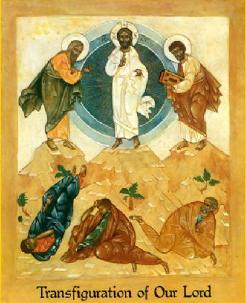
The Transfiguration, then, is a feast of divine glory -­‐ more specifically, of the glory of the Resurrection. The ascent of Mount Tabor came at a critical point in Our Lord’s ministry, just as he was setting out upon His last journey to Jerusalem, which He knew was to end in humiliation and death. To strengthen His disciples for the trials that lay ahead, He chose this particular moment to reveal to them something of His external splendour, ‘as far as they were able to hear it’ (Troparion of the feast). He encouraged them -­‐ and all of us -­‐ to look beyond the suffering of the Cross to the glory of the Resurrection. The light of the Transfiguration, however, foreshadows not only Christ’s own Resurrection on the third day, but equally the Resurrection glory of the righteous at His Second Coming. The glory which shone from Jesus on Tabor is a glory in which all mankind is called to share. On Mount Tabor we see Christ’s human nature -­‐ the human substance which He took from us ­‐ filled with splendour, ‘made godlike’ or ‘deified’. What has happened to human nature in Christ can happen also to the

humanity of Christ’s followers. The Transfiguration, then, reveals to us the full potentiality of our human nature: it shows us the glory which our manhood once possessed and the glory which, by God’s grace, it will again recover at the Last Day.

This is a cardinal aspect of the present feast, to which the liturgical texts frequently revert. At His Transfiguration, it is said, the Lord ‘in His own person showed them the nature of man, arrayed in the original beauty of the Image’ (Great Vespers, postiche). ‘Today Christ on Mount Tabor has changed the darkened nature of Adam, and filling it with brightness He has made it godlike’ (Small Vespers, aposticha). ‘Thou wast transfigured upon Mount Tabor, showing the exchange mortal men will make with Thy glory at Thy second and fearful coming, O Saviour’ (Matins, sessional hymn).

The feast of the Transfiguration, therefore, is not simply the commemoration of a past event in the life of Christ. Possessing also an ‘eschatological’ dimension, it is turned towards the future -­‐ towards the’ splendour of the Resurrection’ at the Last Day, towards the ‘beauty of the Divine Kingdom’ which all Christians hope eventually to enjoy.

It is the custom to bring grapes and fruit to the church on this day. They are placed on a table in the centre of the church and blessed by the priest at the end of the Liturgy.Icon Thransfiguration
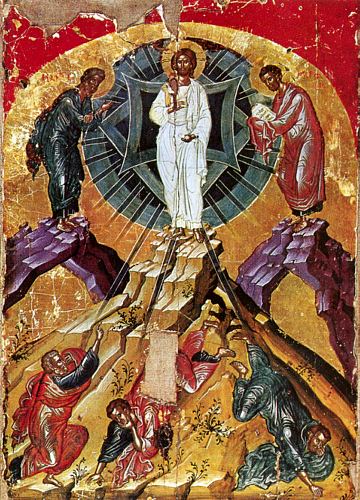
Troparion tone 7: When Thou wast transfigured on the mountain, O Christ our God,/ Thou didst show Thy glory to Thy disciples as far as they could bear it./ Let Thy everlasting light illumine also us sinners/ through the intercessions of the Mother of God./ Giver of Light, glory to Thee.

Kontakion tone 7: Thou wast transfigured on the mountain, O Christ our God,/ and Thy disciples beheld Thy glory as far as they were capable,/ that when they should see Thee crucified,/ they might know that Thy suffering was voluntary/ and might proclaim to the world/ that Thou art indeed the reflection of the Father