11th Sunday After Pentecost

Sts. Isaacius, Dalmatus and Faustus

3 / 16 August 2015

isaakius dalmatusTropar of the Righteous Fathers tone 1: Let us honour the triple choir of righteous fathers,/ glorious Isaac, Dalmatus and Faustus./ They dispel the night of passions by the three-­‐branched candlestick of Christ the Light/ and by their virtues illuminate those who cry:/ Glory to Him Who has made you wonderful; glory to Him Who has magnified you;/ glory to Him Who through you works healings for all.

Kondak of the Righteous Fathers tone 2: By asceticism you shone like lights in the world and by your faith you overthrew heresies./ O Isaac, Dalmatus and Faustus, we praise you with hymns/ as servants of Christ who are praying for us all.


Gospel Matthew 18: 23-­35

Therefore the kingdom of heaven is like a certain king who wanted to settle accounts with his servants. And when he had begun to settle accounts, one was brought to him who owed him ten thousand talents. But as he was not able to pay, his master commanded that he be sold, with his wife and children and all that he had, and that payment be made. The servant therefore fell down before him, saying, ‘Master, have patience with me, and I will pay you all.’ Then the master of that servant was moved with compassion, released him, and forgave him the debt. But that servant went out and found one of his fellow servants who owed him a hundred denarii; and he laid hands on him and took him by the throat, saying, ‘Pay me what you owe!’ So his fellow servant fell down at his feet and begged him, saying, ‘Have patience with me, and I will pay you all.’ And he would not, but went and threw him into prison till he should pay the debt. So when his fellow servants saw what had been done, they were very grieved, and came and told their master all that had been done. Then his master, after he had called him, said to him, ‘You wicked servant! I forgave you all that debt because you begged me. Should you not also have had compassion on your fellow servant, just as I had pity on you?’ And his master was angry, and delivered him to the torturers until he should pay all that was due to him. So My heavenly Father also will do to you if each of you, from his heart, does not forgive his brother his trespasses.”

10th Sunday After Pentecost

The Holy Great Martyr Panteleimon  

27 July / 9 August 2015

pantileimonTropar tone 3: O holy prize-winner and healer Panteleimon,/ intercede with our merciful God/ that He may grant to our souls the forgiveness of our sins

Kondak tone 5: Thou didst faithfully follow the Merciful One/ and wast granted the grace of healing./ O prize-­‐winner and Martyr of Christ our God/ by thine intercessions/ heal the diseases of our souls/ and banish the snares of the enemy/ from those who cry with faith: Save us, O Lord.

The Holy and Great Martyr Panteleimon ­‐ born in Nicomedia of a Christian mother, Eubula, and a pagan father, Eustorgius, he studied medicine as a young man. The priest Hermolaus befriended him, instructed him in the Christian faith and baptised him. Panteleimon miraculously healed a blind man whom other doctors had treated in vain: he healed him by the name of Christ and baptised him. From jealousy, the doctors denounced Panteleimon as a Christian, and he went before the Emperor Maximian for judgement. ‘He stood before the earthly ruler in the body, but in his mind he stood before the heavenly King.’ He freely declared himself to be a Christian before the Emperor, and, in front of his eyes, healed a paralytic of a long infirmity. This miracle brought many of the pagans to the Christian faith. The Emperor put him to torture, but the Lord appeared to him on several occasions and delivered him whole and uninjured. Then St Hermolaus suffered, along with Hermippus and Hermocrates. Condemned to death, St Panteleimon knelt in prayer. At that, the executioner gave him a blow on the neck with his sword, and the sword broke as if made of wax. The executioner could not kill him until he had finished his prayer and had himself given the word to behead him. Panteleimon was beheaded under an olive tree, which after that became laden with fruit. ‘Panteleimon’ means ‘all-­‐merciful’. God the all-­‐merciful received his righteous soul, and glorified him among His greatest saints, his relics remaining incorrupt. This wonderful martyr suffered with honour as a youth for Christ on July 27th, 304. St Panteleimon is invoked in the prayers at the blessing of water and the blessing of oil, together with St Hermolaus and the other unmercenaries and wonderworkers.

Holy Pentecost

Holy Pentecost

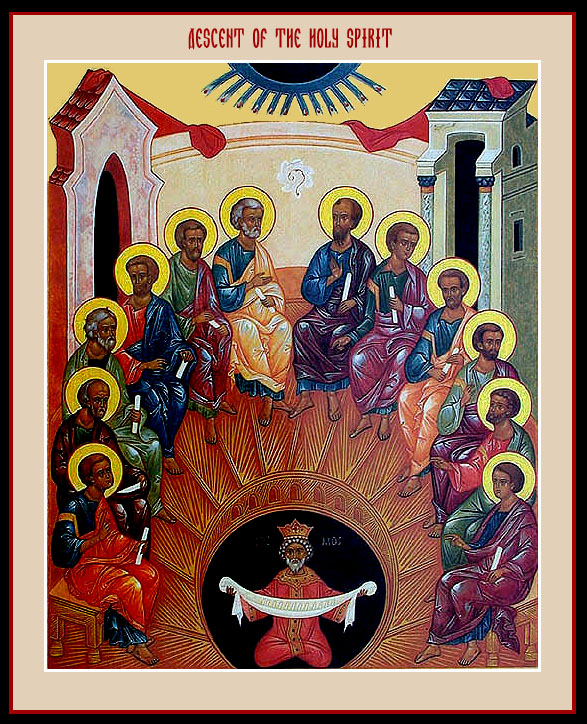
In the Church’s annual liturgical cycle, Pentecost is “the last and great day.” It is the celebration by the Church of the coming of the Holy Spirit as the end—the achievement and fulfillment—of the entire history of salvation. For the same reason, however, it is also the celebration of the beginning: it is the “birthday” of the Church as the presence among us of the Holy Spirit, of the new life in Christ, of grace, knowledge, adoption to God and holiness.

File name            	:DSCN1445.JPG File size            	:641.2KB(656602Bytes) Shoot date           	:2002/05/23 21:35:47 Picture size         	:2048 x 1536 Resolution           	:72 x 72 dpi Number of bits       	:8bit/channel Protection attribute 	:Off Hide Attribute       	:Off Camera ID            	:N/A Model name           	:E995 Quality mode         	:NORMAL Metering mode        	:Multi-pattern Exposure mode        	:Programmed auto Flash                	:No Focal length         	:16.9 mm Shutter speed        	:1/454.5second Aperture             	:F7.2 Exposure compensation	:0 EV Fixed white balance  	:Auto Lens                 	:Built-in Flash sync mode      	:N/A Exposure difference  	:N/A Flexible program     	:N/A Sensitivity          	:Auto Sharpening           	:Auto Curve mode           	:N/A Color mode           	:COLOR Tone compensation    	:AUTO Latitude(GPS)        	:N/A Longitude(GPS)       	:N/A Altitude(GPS)        	:N/A

Troparion — Tone 8
Blessed art You O Christ Our God / You have revealed the fishermen as most wise / By sending down upon them the Holy Spirit / Through them You drew the world into Your net / O Lover of Man, Glory to You!
Kontakion — Tone 8
When the most High came down and confused the tongues, / He divided the nations; / But when he distributed the tongues of fire / He called all to unity. / Therefore, with one voice, we glorify the All-holy Spirit!

The Ascension of our Lord

The Ascension of our Lord

Assention of our Lord

Troparion — Tone 4

O Christ God, You have ascended in Glory, / Granting joy to Your disciples by the promise of the Holy Spirit. / Through the blessing they were assured / That You are the Son of God, / The Redeemer of the world!

Kontakion — Tone 6

When You had fulfilled the dispensation for our sake, / and united earth to heaven: / You ascended in glory, O Christ our God, / not being parted from those who love You, / but remaining with them and crying: / “I am with you and no one will be against you!”

Third Sunday of Pascha 13 / 26April 2015

Sunday of the Myrrh-bearing Women

Myrrh-bearing WomenResurrection Tropar, Tone 2: When Thou didst descend to death, O Life Immortal, Thou didst slay hell with the splendour of Thy Godhead! And when from the depths Thou didst raise the dead, all the powers of Heaven cried
out: O Giver of Life, Christ our God, Glory to Thee.

Tropar of the Sunday Of The Myrrh-bearing Women, Tone 2: The noble Joseph took Thine immaculate Body down from the Tree, / having wrapped It in pure linen and spices, laid in a new tomb. / But on the third day Thou didst rise, O Lord, // granting to the world great mercy.

Kondak of the Sunday Of The Myrrh‐bearing Women, Tone 2: When Thou didst cry, Rejoice, unto the myrrh-­‐bearers,/ Thou didst make the lamentation of Eve the first mother to cease / by Thy Resurrection, O Christ God. / And Thou didst bid Thine apostles to preach: // The Saviour is risen from the grave.

Kondak of Pascha, Tone 8: Though Thou didst descend into the grave, O Immortal One, yet didst Thou destroy the power of Hades, and didst arise as victor, O Christ God, calling to the myrrh-­‐bearing women, Rejoice, and giving peace unto Thine Apostles, O Thou Who dost grant resurrection to the fallen.

The Gospel According To St. Mark 15: 43 ­‐ 16: 8

Joseph of Arimathea, a prominent council member, who was himself waiting for the kingdom of God, coming and taking courage, went in to Pilate and asked for the body of Jesus. Pilate marvelled that He was already dead; and summoning the centurion, he asked him if He had been dead for some time. So when he found out from the centurion, he granted the body to Joseph. Then he bought fine linen, took Him down, and wrapped Him in the linen. And he laid Him in a tomb which had been hewn out of the rock, and rolled a stone against the door of the tomb. And Mary Magdalene and Mary the mother of Joses observed where He was laid. Now when the Sabbath was past, Mary Magdalene, Mary the mother of James, and Salome bought spices, that they might come and anoint Him. Very early in the morning, on the first day of the week, they came to the tomb when the sun had risen. And they said among themselves, “Who will roll away the stone from the door of the tomb for us?” But when they looked up, they saw that the stone had been rolled away for it was very large. And entering the tomb, they saw a young man clothed in a long white robe sitting on the right side; and they were alarmed. But he said to them, “Do not be alarmed. You seek Jesus of Nazareth, who was crucified. He is risen! He is not here. See the place where they laid Him. But go, tell His disciples and Peter­ that He is going before you into Galilee; there you will see Him, as He said to you.” So they went out quickly and fled from the tomb, for they trembled and were amazed. And they said nothing to anyone, for they were afraid.

THE MYRRH­‐BEARING WOMEN

Mark how great the women’s assiduity. They had followed Him, ministering to Him, and were present even to the time of the dangers. This is why they also saw all; how He cried, how He gave up the ghost; how the rocks were rent and all the rest. These women were the first to see Jesus; and the sex that was most condemned first enjoys the sight of the blessings; this sex shows its courage the most. And when the disciples had fled, these were present. Joseph, who had been concealing his discipleship of late, now became very bold after the death of Christ. He was by no means an obscure person …but one of the council …He exposed himself to death, taking great enmity upon him from all by his affection for Jesus …Do you see the women’s courage? Do you see their affection? Do you see their noble spirit in matters of money? their noble spirit even unto death? Let the men imitate the women; let us not forsake Jesus in temptation …But we neither feed Him when hungry, nor clothe Him when naked (Cf. Matt.25), but seeing Him go begging, we pass Him by. And yet if we saw Him in fact, everyone would strip himself of all his goods.

St. John Chrysostom. Homily LXXXVIII on Matthew XXVII, 1. B#54, p. 522.

Paschal Service at The Holy Trinity Church 12/04/2015

PASCHA

The Bright and Glorious Resurrection of our Lord, God and Saviour Jesus Christ

Paskha

Enjoy ye all the feast of faith; receive ye all the riches of loving-kindness.
(Sermon of St John Chrysostom, read at Paschal Matins)

This is the day of resurrection.
Let us be illumined by the feast.
Let us embrace each other.
Let us call “brothers” even those who hate us,
And forgive all by the resurrection. . .

The resurrection of Jesus Christ from the dead is the center of the Christian faith. St Paul says that if Christ is not raised from the dead, then our preaching and faith are in vain (I Cor. 15:14). Indeed, without the resurrection there would be no Christian preaching or faith. The disciples of Christ would have remained the broken and hopeless band which the Gospel of John describes as being in hiding behind locked doors for fear of the Jews. They went nowhere and preached nothing until they met the risen Christ, the doors being shut (John 20: 19). Then they touched the wounds of the nails and the spear; they ate and drank with Him. The resurrection became the basis of everything they said and did (Acts 2-4): “. . . for a spirit has not flesh and bones as you see that I have” (Luke 24:39).

The resurrection reveals Jesus of Nazareth as not only the expected Messiah of Israel, but as the King and Lord of a new Jerusalem: a new heaven and a new earth.

Then I saw a new heaven and a new earth. . . the holy city, new Jerusalem. And I heard a great voice from the throne saying “Behold, the dwelling place of God is with men. He will dwell with them, and they shall be his people. . . He will wipe away every tear from their eyes, and death shall be no more, neither shall there be mourning nor crying nor pain any more, for the former things have passed away (Rev. 21:1-4).

In His death and resurrection, Christ defeats the last enemy, death, and thereby fulfills the mandate of His Father to subject all things under His feet (I Cor. 15:24-26).

Worthy is the Lamb who was slain, to receive power and wealth and wisdom and might and honor and glory and blessing (Rev. 5: 12)

Great and Holy Saturday

Great and Holy Saturday

Christ in the TombGreat and Holy Saturday is the day on which Christ reposed in the tomb. The Church calls this day the Blessed Sabbath.

“The great Moses mystically foreshadowed this day when he said:
God blessed the seventh day.
This is the blessed Sabbath
This is the day of rest,
on which the only-begotten Son of God rested from all His works….”

(Vesperal Liturgy of Holy Saturday)

By using this title the Church links Holy Saturday with the creative act of God. In the initial account of creation as found in the Book of Genesis, God made man in His own image and likeness. To be truly himself, man was to live in constant communion with the source and dynamic power of that image: God. Man fell from God. Now Christ, the Son of God through whom all things were created, has come to restore man to communion with God. He thereby completes creation. All things are again as they should be. His mission is consummated. On the Blessed Sabbath He rests from all His works.

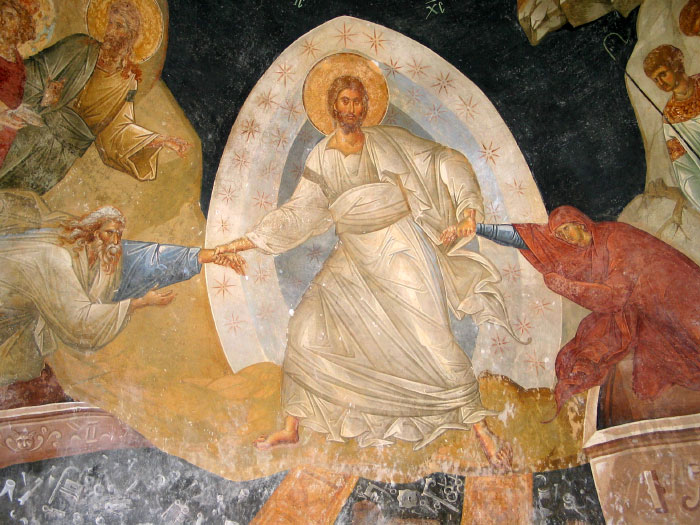
THE ICON OF THE DESCENT INTO HADES

Descent into  HadesThe traditional icon used by the Church on the feast of Easter is an icon of Holy Saturday: the descent of Christ into Hades. It is a painting of theology, for no one has ever seen this event. It depicts Christ, radiant in hues of white and blue, standing on the shattered gates of Hades. With arms outstretched He is joining hands with Adam and all the other Old Testament righteous whom He has found there. He leads them from the kingdom of death. By His death He tramples death.

“Today Hades cries out groaning:
I should not have accepted the Man born of Mary.
He came and destroyed my power.
He shattered the gates of brass.
As God, He raised the souls I had held captive.
Glory to Thy cross and resurrection, O Lord!”
(Vesperal Liturgy of Holy Saturday)

Great and Holy Friday

Great and Holy Friday (10 April 2015)

On Great and Holy Friday, Christ died on the Cross. He gave up His spirit with the words: “It is finished” (John 19:30). These words are better understood when rendered: “It is consummated.” He had accomplished the work for which His heavenly Father had sent Him into the world. He became a man in the fullest sense of the word. He accepted the baptism of repentance from John in the Jordan River. He assumed the whole human condition, experiencing all its alienation, agony, and suffering, concluding with the lowly death on the Cross. He perfectly fulfilled the prophecy of Isaiah:

“Therefore I will divide him a portion with the great, and he shall divide the spoil with the strong; because he has poured out his soul to death, and was numbered with the transgressors; yet he bore the sins of many, and made intercession for the transgressors.” (Isaiah 53:12)

Gewat Holy Friday
Troparion — Tone 2

The Noble Joseph, / When he had taken down Your most pure Body from the tree, / Wrapped it in fine linen, / And anointed it with spices, / And placed it in a new tomb.

Troparion — Tone 2

The angel came to the myrrh-bearing women at the tomb and said: / Myrrh is fitting for the dead, / But Christ has shown Himself a stranger to corruption.

Kontakion — Tone 8

Come, let us all sing the praises of Him who was crucified for us, / For Mary said when she beheld Him upon the tree: / Though You do endure the cross, You are my Son and my God!

Great and Holy Thursday (Thursday 9 April 2015)

Great and Holy Thursday  ( 9 April 2015)

The Last Supper.

The Last SupperTwo events shape the liturgy of Great and Holy Thursday: the Last Supper of Christ with His disciples, and the betrayal of Judas. The meaning of both is in love. The Last Supper is the ultimate revelation of God’s redeeming love for man, of love as the very essence of salvation. And the betrayal of Judas reveals that sin, death and self-destruction are also due to love, but to deviated and distorted love, love directed at that which does not deserve love. Here is the mystery of this unique day, and its liturgy, where light and darkness, joy and sorrow are so strangely mixed, challenges us with the choice on which depends the eternal destiny of each one of us. “Now before the feast of the Passover, when Jesus knew that His hour was come… having loved His own which were in the world, He loved them unto the end…” (John 13:1). To understand the meaning of the Last Supper we must see it as the very end of the great movement of Divine Love which began with the creation of the world and is now to be consummated in the death and resurrection of Christ.

Great and Holy Thursday – Troparion & Kontakion

Troparion — Tone 6

Of Your Mystical Supper, O Son of God, / Accept me today as a communicant. / For I will not speak of Your mysteries to Your enemies, / Neither like Judas will I give You a kiss, / But like the thief will I confess You. / Remember me, O Lord, in Your Kingdom!

Troparion — Tone 4

By Your precious blood, / You have redeemed us from the curse of the law. / By being nailed to the cross and pierced by a spear, / You have poured forth immortality for man. / O our Savior, glory to You!

Kontakion — Tone 8

Come, let us all sing the praises of Him who was crucified for us, / For Mary said when she beheld Him upon the tree: / Though You do endure the cross, You are my Son and my God!