The Third Sunday of Great Lent

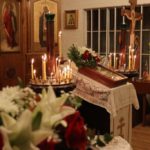
The Third Sunday of Great Lent / Veneration of the Holy Cross 

(26 February / 11 March)

Veneration of the CrossTropar of the Holy Cross, Tone 1: Save O Lord Thy people and bless Thine inheritance / Granting unto Orthodox Christians victory over their enemies / and by the power of Thy cross / preserving Thy community.

Kondak of the Holy Cross, Tone 4: O Thou Who wast lifted up willingly on the Cross, bestow Thy mercies upon the new community named after Thee, O Christ God: gladden with Thy power the Orthodox Christians, granting them victory over enemies; may they have as Thy help the weapon of peace, the invincible trophy.

Lenten Synaxarion: Cross Veneration Sunday

Let all the earth venerate the Cross, through which it has learned to worship Thee, the Word.

On this third Sunday of the Great Fast we celebrate the Veneration of the precious and life-giving Cross. Since during the forty days of the Fast we are also in a way crucified, mortified to the passions, contrite, abased and despondent, the precious and life-giving Cross is offered to us as refreshment and confirmation, calling to mind the Passion of our Lord Jesus Christ and comforting us. If our God was crucified for our sake, how great should be our effort for His sake, since our afflictions have been assuaged through the Lord’s tribulations, and by the commemoration and the hope of the Cross of glory. For as our Savior in ascending the Cross was glorified through dishonor and grief; so should we also endure our sorrows, in order to be glorified with Him. Also, as those who have traveled a long hard road, weighed down by the labors of their journey, in finding a shady tree, take their ease for a moment and continue their journey rejuvenated, so now in this time of the Fast, this sorrowful and laborious journey, the Holy Fathers have planted the life-giving Cross, for our relief and refreshment, to encourage and make easier the labors that lie ahead. Or as when there is a royal procession, the king’s scepter and banners precede him, he then appears himself, radiant and joyous in his victory, causing his subjects to rejoice with him. So then our Lord Jesus Christ, desiring to show His sure victory over death and His glory on the day of the Resurrection, sends His scepter before Himself, the sign of His kingship, the life-giving Cross, to gladden and refresh us, as it greatly fortifies and enables us to be prepared to receive the King with all possible strength, and to praise Him in His radiant victory.

This week lies at the middle of the holy Forty Day Fast. The Fast is like a bitter source because of our contrition and the sadness and sorrow for sin that it brings. And as Moses plunged the branch in the bitter waters of Marah, making them sweet, so God, who has led us through the spiritual Red Sea away from Pharaoh, through the life-giving wood of the precious and life-giving Cross sweetens the bitterness of the Forty Day Fast, and comforts us as those who were in the wilderness, up until the time when by His Resurrection He will lead us to the spiritual Jerusalem. And since the Cross is called, and indeed is, the Tree of Life, it is the very tree that was planted in the Garden of Eden. So it is fitting that the Holy Fathers have planted the Tree of the Cross in the middle of the Forty Day Fast to commemorate both Adam’s tasting of its sweet fruit and of its being taken from us in favor of the Tree of the Cross, tasting of which we shall in no way die, but will have even greater life.

Through the power of Thy Cross, O Christ our God, preserve us also from the temptations of the Evil One. And make us worthy to venerate Thy divine Passion and life-bearing Resurrection, having radiantly traversed the great length of the Fast, and have mercy on us, as Thou art good and lovest mankind.

Amen.

https://gallery.mailchimp.com/81553b4892e372f9f990fc39d/files/a0318749-2bbe-4ce4-91a5-516e65fefac0/Lent3_VenerationOfTheHolyCross.01.pdf

The Second Sunday of Great Lent

The Second Sunday of Great Lent / St Gregory Palamas, Archbishop of Thessolonica

St. Gregory PalamaTropar of St. Gregory Palamas, Tone 8: Light of Orthodoxy, pillar and teacher of the Church, adornment of monastics, invincible champion of theologians, O Gregory thou wonderworker, boast of Thessalonica, herald of grace, ever pray that our souls be saved.

Kontakion from the Triodion, Tone 4: The season of the virtues hath now been revealed / and judgement is at the doors / therefore let us arise and keep the Fast / offering tears of compunction together with our alms / and let us cry: our sins are more than the sands of the sea / but do Thou pardon us, O Creator of all // that we may receive incorruptible crowns.

St. Gregory Palamas

Gregory’s father was an eminent official at the court of the Emperor Andronicus II Palaeologus. The gifted Gregory, completing his secular studies, did not want to go into imperial service at court, but withdrew to the Holy Mountain and became a monk, living in asceticism at Vatopedi and the Great Lavra. He waged war against the heretic Barlaam, and finally overcame him. He was consecrated Metropolitan of Salonica in 1347, being glorified both as an ascetic and a theologian, both as a hierarch and a wonderworker.. He was the defender of the Hesychasts. He upheld the doctrine that the human body played an important part in prayer, and he argued that the Hesychasts did indeed experience the Divine and Uncreated Light of Tabor. To explain how this was possible, St. Gregory developed the distinction between the essence and the energies of God. He set Hesychasm on a firm dogmatic basis, by integrating it into Orthodox theology, and by showing how the Hesychast vision of Divine Light in no way undermined the doctrine that God can not be comprehended. His teachings were confirmed by the local councils held in Constantinople in 1341 and 1351. St. Gregory began by reaffirming the Biblical

doctrine of man and of the Incarnation; i.e. the whole man, united in body and soul, was created in the image of God, and Christ, by taking a human body at the Incarnation, has ‘made the flesh an inexhaustible source of sanctification’. The Hesychasts, so he argued, in placing emphasis on the body’s part in prayer, are not guilty of a gross materialism but are simply remaining faithful to the Biblical doctrine of man as a unity. Christ took human flesh and saved the whole man; therefore it is the whole man that prays to God. How is it possible for man to know God and, at the same time, affirm that God is by nature unknowable? St. Gregory answered this question by quoting St. Basil the Great who said “We know our God from His energies, but we do not claim that we can draw near to His essence. For His energies come down to us, but His essence remains unapproachable”. St. Gregory added “God is not a nature, for He is above all beings…. No single thing of all that is created has or ever will have even the slightest communion with the supreme nature, or nearness to it”. Even though God’s essence may be remote from us, He has revealed Himself through His energies (or grace). These energies do not exist apart from God, but are God Himself in His action and revelation to the world. It is through these energies that God enters into a direct and immediate relationship with us. When we say that the saints are ‘deified’ by the grace of God, we mean that they have a direct experience of God Himself through his energies (or grace), not in His essence. The vision of Light that Hesychasts receive is the same Light that surrounded Christ on Mount Tabor. It is a true vision of God in His divine energies.

First Sunday of Great Lent

The First Sunday of Great Lent / The Sunday of Orthodoxy 12 / 25 February

Sunday of Orthodoxy iconThe First Sunday of Great Lent, Troparion, Tone II : We worship Thy immaculate Image, O Good One, and ask forgiveness of our sins, O Christ God; for of Thy own will Thou wast pleased to ascend the Cross in the flesh, to deliver from slavery to the enemy those whom Thou hadst created. Therefore we thankfully cry to Thee: Thou hast filled all things with joy, O our Saviour, by coming to save the world.

Kondak First Sunday of Great Lent, Tone 8: The Uncircumscribable Word of the Father was circumscribed when he took flesh of thee, O Theotokos; and when He had restored the defiled image to its ancient state, He suffused it with divine beauty. As for us, confessing our salvation, we record it in deed and word.

The Sunday of Orthodoxy

On this day the Church commemorates the final ending of the Iconoclast controversy and the definitive restoration of the holy icons to the churches by the Empress Theodora, acting as Regent for her young son Michael III. This took place on the first Sunday in Lent, 11 March 843. There is, however, not only an historical link between the first Sunday and the restoration of the icons but also a spiritual affinity. If Orthodoxy triumphed in the epoch of the Iconoclast controversy, this was because so many of the faithful were prepared to undergo exile, torture, and even death, for the sake of the truth. The Feast of Orthodoxy is above all a celebration in honour of the martyrs and confessors who struggled and suffered for the faith: hence its appropriateness for the season of Lent, when we are striving to imitate the martyrs by means of our ascetic self-denial. The fixing of the Triumph of Orthodoxy on the first Sunday is therefore much more than the result of some chance historical conjunction.

The Triodion gives the text of a special ‘Office of the Triumph of Orthodoxy’, which is held at the end of Matins or, more commonly, at the end of the Divine Liturgy on this Sunday. The Office celebrates not only the restoration of the holy icons but, more generally, the victory of the true faith over all heresies and errors. A procession is made with the holy icons, and after this extracts are read from the synodical decree of the Seventh Ecumenical Council (787). Then sixty anathemas are pronounced against various heretics dating from the third to the fourteenth century; ‘Eternal Memory’ is sung in honour of the emperors, patriarchs and fathers who defended the Orthodox faith; and ‘Many Years’ is proclaimed in honour of our present rulers and bishops. Unfortunately in many parts of the Orthodox Church today this impressive service has fallen into disuse; elsewhere it is performed in a greatly abbreviated form.

Before the Triumph of Orthodoxy came to be celebrated on the first Sunday, there was on this day a commemoration of Moses, Aaron, Samuel, and the prophets. Traces of this more ancient observance can still be seen in the choice of Epistle reading at the Liturgy (Hebrews 11: 24-6, 32-40), and in the Alleluia verse appointed before the Gospel: ‘Moses and Aaron among His priests, and Samuel among them that call upon His Name’.

Maslenitsa (Pancake Week)


Forgiveness Sunday

Forgiveness Sunday (Cheesefare Sunday),Commemoration of the exile of Adam from Paradise.

The Sunday of Forgiveness is the last Sunday prior to the commencement of Great Lent. During the pre
-Lenten period, the services of the Church include hymns from the Triodion, a liturgical book that contains the services from the Sunday of the Publican and the Pharisee, the tenth before Pascha,through Great and Holy Saturday.
On the Sunday of Forgiveness focus is placed on the exile of Adam and Eve from the Garden of Eden, and event that shows us how far we have fallen in sin and separated ourselves from God. At the onset of Great Lent and a period of intense fasting, this Sunday reminds us of our need for God’s forgiveness and guides our hearts, minds, and spiritual efforts on returning to Him in repentance.

The Feast of Theophany

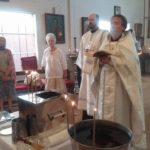
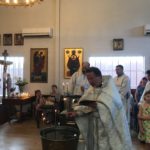
The Feast of Theophany with Blessing of Water at our church 19/01/2018

Theophany of our Lord and Savior Jesus Christ

Theophany of our Lord and Savior Jesus Christ – 6 (19) January

Icon of The Theophany of our Lord

Troparion — Tone 1

When You, O Lord were baptized in the Jordan / The worship of the Trinity was made manifest / For the voice of the Father bore witness to You / And called You His beloved Son. / And the Spirit, in the form of a dove, / Confirmed the truthfulness of His word. / O Christ, our God, You have revealed Yourself / And have enlightened the world, glory to You!

Kontakion — Tone 4

Today You have shown forth to the world, O Lord, / and the light of Your countenance has been marked on us. / Knowing You, we sing Your praises. / You have come and revealed Yourself, / O unapproachable Light.

Christmas Service 2018 (7 January 2018)


The Nativity of our Lord God and Saviour Jesus Christ

The Nativity of our Lord God and  Saviour Jesus Christ  25 December /  7 January

Nativity Icon

The Nativity of our Lord God and Savior Jesus Christ

Tropar of the Nativity (Tone 4): Thy Nativity, O Christ our God, hath shined upon the world the light of knowledge; for thereby, they that worshipped the stars were taught by a star to worship Thee, the Sun of Righteousness, and to know Thee, the Dayspring from on high. O Lord, glory be to Thee.

Kontakion of the Nativity (Tone 3): Today the Virgin giveth birth to Him Who is transcendent in essence; and the earth offereth a cave to Him Who is unapproachable.  Angels with shepherds give glory; with a star the Magi do journey; for our sake a young Child is born, Who is pre-eternal God.

Gospel: Matt. 2:1-12

1 When Jesus was born in Bethlehem of Judea in the days of Herod the king, behold, there came wise men from the east to Jerusalem, 2 Saying, Where is he that is born King of the Jews? for we have seen his star in the east and are come to worship him.’ 3 When Herod the king heard these things, he was troubled, and all Jerusalem with him. 4 And when he had” gathered all the chief priests and scribes of the people together, he demanded of them where Christ should be born. 5 and they said unto him, In Bethlehem of Judea: for thus it is written by the prophet, 6 And thou Bethlehem, in the land of Judah, art not the least among the princes of Judah: for out of thee shall come a Governor, that shall rule my people Israel. 7 Then Herod, when he had privily called the wise men, inquired of them diligently what time the star appeared. 8 And he sent them to Bethlehem and said, Go and search diligently for the young child; and when ye have found him, bring me word again, that I may come and worship him also. 9 When they heard the king, they departed: and 10, the star, which they saw in the east, went before them, till it came and stood over where the young child was. 10 When they saw the star, they rejoiced with exceeding great joy. 11 And when they were come into the house, they saw the young child with Mary, his mother, and fell down, and worshiped him: and when they had opened their treasures, they presented unto him gifts: gold, and frankincense, and myrrh. 12 And being warned of God in a dream that they should not return to Herod, they departed into their own country another way.

BUT WHEN THE FULLNESS OF THE TIME WAS COME, GOD SENT FORTH HIS SON

And so, my brothers, the feast of the Nativity of Christ reminds us that we are born of God, that we are sons of God (I John 3:1), that we have been saved from sin (Matt. 1:21) and that we must live for God and not sin; not for flesh and blood, not for the world which lies in evil (I John 5: 19). What does the Incarnation of the Son of God require of us? It requires of us to remember and hold in sacred honour the fact that we are born of God; and if we have sullied and trampled upon this birthright with our sins, we must restore it by washing it with tears of repentance; we must restore and renew within us the image of God which has fallen and the union with God and blessedness, truth and holiness which has been destroyed.’Now God became man, that He may make Adam a god’ (Stichera for lauds of Annunciation).

St. John of Kronstadt,. My Life in Christ. B#61.

There is no need to fear that God should seem to suffer constraint in the tiny body of a child: for God is not in size, but in moral power …That moral power, without changing for the worse, took to itself the rational soul, and through that the human body, and the whole man, to change it for the better; in condescension taking from it the name of humanity, in generosity bestowing on it the name of divinity.

St. Augustine of Hippo. Letters, 137.8. B#15, p.216.

VISIT OF THE MAGI

The three wisardsWhat do the wise men learn from the star? …That He was King of the Jews? And yet He was not king of this kingdom, even as He also said to Pilate, ‘My kingdom is not of this world’ …And even if they knew Him to be a king, for what intent did they come? …What had astrology to do with Him? …What reason induced them to worship one who was king so far off …not yet grown to manhood? Why do they set forth on so long a journey and offer gifts and this when dangers were sure to beset their whole proceedings? …God called them by the things that are familiar …and He shows a large and extraordinary star, so as to astonish them …Yet for all that, God, for the salvation of those who are in error, endured to be served by these things whereby those without were used to serve devils (astrology); only He slightly altered them; that He might draw them off by degrees from their customs, and lead them towards the higher wisdom.

St. John Chrysostom. Homily VI on Matthew 2, 1,4. B#54,pp. 36,37,  

The Dormition

15 / 28 August –The Dormition of Our Most Holy Lady the Theotokos and Ever-virgin Mary

The dormition

Troparion tone 1:

In giving birth thou didst keep thy virginity,/ and in thy dormition thou didst not forsake the world, O
Mother of God./ Thou didst pass on to life, since thou art the Mother of Life,/ and by thine intercessions thou redeemest our souls from death.

Kontakion tone 2:

The grave and death could not hold the Mother of God,/ who is sleepless in her intercessions and an unchanging hope in her mediations./ For as the Mother of Life she was transferred to life/ by Him Who dwelt in her ever-virgin womb.

The Dormition

The Lord Who, on Mt. Sinai, commanded by His Fifth Commandment: “Honor your father and your mother”
(Exodus 20:12), showed by His own example how one should respect one’s parent. Hanging on the Cross
in agony, He remembered His mother and indicating to the Apostle John, said to her: “Woman behold
your son” (St. John 19:26). After that, He said to John: “Behold your mother” (St. John 19:27). And so
providing for His mother, He breathed His last. John had a home on Zion in Jerusalem in which the
Theotokos settled and remained there to live out the end of her days on earth.
By her prayers, gentle counsels, meekness and patience, she greatly assisted the apostles of her Son. Primarily, she spent her entire time in Jerusalem often visiting those places which reminded her of the great events and of the great works of her Son. She especially visited Golgotha, Bethlehem and the Mount of Olives. Of her distant journeys, her visit to St. Ignatius the Theophorus [God-bearer] in Antioch is mentioned, as well as hervisit to Lazarus (whom our Lord resurrected on the fourth day), the Bishop of Cyprus, her visit to the
Holy Mountain [Athos] which she blessed and her stay in Ephesus with St. John the Evangelist [The Theologian] during the time of the great persecution of Christians in Jerusalem.
In her old age, she often prayed to the Lord and her God on the Mount of Olives, the site of His Ascension,that He take her from this world as soon as possible.
On one occasion, the Archangel Gabriel appeared to her and revealed to her that within three days she will find repose. The angel gave her a palm branch to be carried at the time of her funeral procession. She returned to her home with great joy, desiring in her heart once more to see in this life, all of the apostles of Christ. The Lord fulfilled her wish and all of the apostles, borne by angels in the clouds,gathered at the same time at the home of John on Zion. With great rejoicing, she saw the holy apostles, encouraged them,counselled them and comforted them. Following that, she peacefully gave up her soul to God without any pain or physical illness.
The apostles took the coffin with her body from which an aromatic fragrance emitted and, in the company of many Christians, bore it to the Garden of Gethsemane to the sepulchre of [her parents], Saints Joachim and Anna. By God’s Providence, they were concealed from the evil Jews by a cloud. Anthony, a Jewish priest, grabbed the coffin with his hands with the intention of overturning it but, at that moment, an angel of God severed both his hands. He then cried out to the apostles for help and was healed since declaring his faith in the Lord Jesus Christ.
The Apostle Thomas was absent, again according to God’s Providence, in order that a new and all-glorious mystery of the Holy Theotokos would again be revealed.On the third day, Thomas arrived and desired to venerate [kiss] the body of the Holy All-pure one. But when the apostles opened the sepulchre, they found only the winding sheet and the body was not in the tomb. That evening, the Theotokos appeared to the apostles surrounded by a myriad of angels and said to them: “Rejoice, I will be with you always”.
It is notexactly known how old the Theotokos was at the time of her Falling Asleep but the overwhelming opinion is that she was over sixty years of age.