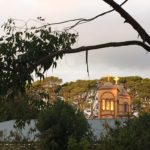
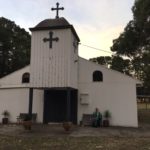
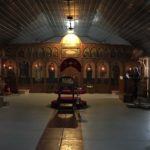
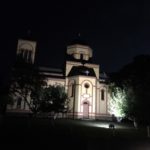
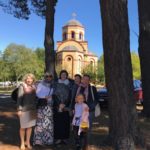
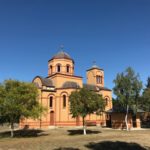
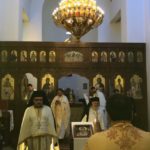
Paskhal Service in our church 08 April 2018
Christ is risen!


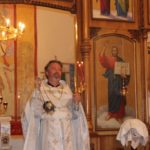

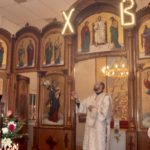
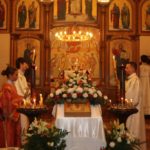
 Christ is risen from the dead,
trampling down death by death,
and upon those in the tombs bestowing life!
Enjoy ye all the feast of faith; receive ye all the riches of loving-kindness.
(Sermon of Saint John Chrysostom, read at Paschal Matins)
The resurrection of Jesus Christ from the dead is the center of the Christian faith. Saint Paul says that if Christ is not raised from the dead, then our preaching and faith are in vain (I Cor. 15:14). Indeed, without the resurrection there would be no Christian preaching or faith. The disciples of Christ would have remained the broken and hopeless band which the Gospel of John describes as being in hiding behind locked doors for fear of the Jews. They went nowhere and preached nothing until they met the risen Christ, the doors being shut (John 20: 19). Then they touched the wounds of the nails and the spear; they ate and drank with Him. The resurrection became the basis of everything they said and did (Acts 2-4): “. . . for a spirit has not flesh and bones as you see that I have” (Luke 24:39).
 Master Bless – IF any be pious and a lover of God, let him delight in this fair and radiant festival. If any be an honest servant, let him come in and rejoice in the joy of his Lord. If any have wearied himself with fasting, let him now enjoy the recompense. If any have worked from the first hour, let him receive today his just reward. If any have come after the third, let him feast with thankfulness. If any have arrived after the sixth, in no wise let him be in doubt; in no way shall he suffer loss. If any be later than the ninth, let him draw nigh, let him not waver. If any arrive only at the eleventh, let him not be fearful for his slowness, for the Master is munificent and receiveth the last even as the first; He giveth rest to him of the eleventh even as to him who hath wrought from the first hour. He is merciful to the last and provideth for the first; and to this one He giveth, and to that one He showeth kindness. He receiveth their labours and acknowledgeth the purpose, and He honoureth the deed and praiseth the intention. Wherefore, enter ye all into the joy of our Lord, and let the first and the second take part in the reward. Ye rich and ye poor, join hands together. Ye sober and ye heedless, do honour to this day. Ye who fast and ye who fast not, be glad today. The table is full: do ye all fare sumptuously. The calf is ample: let no one go forth hungry. Let all enjoy the banquet of Faith. Let all enjoy the wealth of righteousness. Let no one lament his poverty, for the Kingdom is made manifest to all. Let no one bewail transgressions, for forgiveness hath dawned forth from the tomb. Let no one be fearful of Death, for the death of the Saviour hath set us free. He hath quenched Death by being subdued by Death. He Who came down into Hades, despoiled Hades; and Hades was embittered when he tasted of Christ’s Flesh. Isaiah, anticipating this, cried out and said: Hades was embittered when below he met Thee face to face. He was embittered, for he was set at nought. He was embittered, for he was mocked. He was embittered, for he was slain. He was embittered, for he was cast down. He was embittered, for he was fettered. He received a body, and encountered God. He received earth, and met Heaven face to face. He received what he saw, and fell whither he saw not. O Death, where is thy sting? O Hades, where is thy victory? Risen is Christ, and thou art overthrown. is Christ, and the demons are fallen. Risen is Christ, and the Angels rejoice. . Risen is Christ, and life doth reign. Risen is Christ, and there is none dead in the tomb. For Christ is raised from the dead, and is become the first-fruits of them that slept. To Him be glory and dominion unto the ages of ages. Amen.
Great and Holy Saturday is the day on which Christ reposed in the tomb. The Church calls this day the Blessed Sabbath.
 “The great Moses mystically foreshadowed this day when he said:
God blessed the seventh day.
This is the blessed Sabbath
This is the day of rest,
on which the only-begotten Son of God rested from all His works….”
(Vesperal Liturgy of Holy Saturday)
By using this title the Church links Holy Saturday with the creative act of God. In the initial account of creation as found in the Book of Genesis, God made man in His own image and likeness. To be truly himself, man was to live in constant communion with the source and dynamic power of that image: God. Man fell from God. Now Christ, the Son of God through whom all things were created, has come to restore man to communion with God. He thereby completes creation. All things are again as they should be. His mission is consummated. On the Blessed Sabbath He rests from all His works.
THE ICON OF THE DESCENT INTO HADES
The traditional icon used by the Church on the feast of Easter is an icon of Holy Saturday: the descent of Christ into Hades. It is a painting of theology, for no one has ever seen this event. It depicts Christ, radiant in hues of white and blue, standing on the shattered gates of Hades. With arms outstretched He is joining hands with Adam and all the other Old Testament righteous whom He has found there. He leads them from the kingdom of death. By His death He tramples death.
 Troparion — Tone 2
When You did descend to death, O Life Immortal, / You did slay hell with the splendor of Your Godhead, / And when from the depths You did raise the dead, / All the Powers of Heaven cried out, / O Giver of Life, Christ our God, glory to You!
Kontakion — Tone 6
He who shut in the depths is beheld dead, / Wrapped in fine linen and spices. / The Immortal One is laid in a tomb as a mortal man. / The women have come to anoint Him with myrrh, / Weeping bitterly and crying: / “This is the most blessed Sabbath / On which Christ has fallen asleep to rise on the third day!”
 When the most holy Virgin had lived and served in the Temple at Jerusalem for eleven years, and was by then fourteen years old— when, that is, she was entering on her fifteenth year—the priests informed her that, according to the Law, she could no longer remain in the Temple but must be betrothed and marry. But, to the great surprise of all the priests, the most holy Virgin replied that she had dedicated herself to God and wished to a maiden remain till death and enter into wedlock with no-one. Then, by God’s providence and under His inspiration, Zacharias, the high priest and father of the Forerunner, in consultation with the other priests, chose twelve unmarried men from the tribe of David so that they might entrust the Virgin Mary to one of them to preserve her virginity and care for her. She was thus entrusted to Joseph, an old man from Nazareth and a kinsman of hers. In his house, the most holy Virgin continued to live in the same manner as in the Temple of Solomon, passing her time in the reading of the sacred Scriptures, in prayer, in pondering on the works of God, in fasting and in handwork. She scarcely ever left the house, nor took an interest in worldly matters or events. She generally conversed very little with anyone, and never without a particular need. She was close friends only with the two daughters of Joseph. But when the time prophesied by the Prophet Daniel had come and when God was pleased to fulfil the promise made to Adam when He drove him out of Paradise, and to the prophets, the mighty Archangel Gabriel appeared in the chamber of the most holy Virgin, at the precise moment (as some priestly writers have related) that she was holding open on her lap the book of the Prophet Isaiah and pondering on his great prophecy: ‘Behold, a virgin shall conceive and bear a son’. Gabriel appeared to her in angelic light and said to her: ‘Rejoice, thou that art highly favoured, the Lord is with thee!’, and so forth, just as is related in the Gospel of the divine Luke. With this angelic greeting and the descent of the Holy Spirit, the salvation of mankind and the renewal of creation were set in motion. The Archangel turned the first page of the story of the New Testament with the word ‘Rejoice!’, to show by this the joy that the New Testament signifies for mankind and for all things created. And therefore the Annunciation is looked upon as a joyous, as well as a great, feast;
On Great and Holy Friday, Christ died on the Cross. He gave up His spirit with the words: “It is finished” (John 19:30). These words are better understood when rendered: “It is consummated.” He had accomplished the work for which His heavenly Father had sent Him into the world. He became a man in the fullest sense of the word. He accepted the baptism of repentance from John in the Jordan River. He assumed the whole human condition, experiencing all its alienation, agony, and suffering, concluding with the lowly death on the Cross. He perfectly fulfilled the prophecy of Isaiah:
“Therefore I will divide him a portion with the great, and he shall divide the spoil with the strong; because he has poured out his soul to death, and was numbered with the transgressors; yet he bore the sins of many, and made intercession for the transgressors.”
(Isaiah 53:12)
 The Man of Sorrows
On the Cross Jesus thus became “the man of sorrows; acquainted with grief” whom the prophet Isaiah had foretold. He was “despised and forsaken by men” and “smitten by God, and afflicted” (Isaiah 53:3-4). He became the one with “no form or comeliness that we should look at him, and no beauty that we should desire him” (Isaiah 53:2). His appearance was “marred beyond human semblance, and his form beyond that of the sons of men” (Isaiah 52:14). All these Messianic prophecies were fulfilled in Jesus as he hung from the Cross.
As the end approached, He cried: “My God, my God, why hast Thou forsaken me?” (Matthew 27:46). This cry indicated His complete identification with the human condition. He had totally embraced the despised, forsaken and smitten condition of suffering and death—alienation from God. He was truly the man of sorrows.
Yet, it is important to note that Jesus’ cry of anguish from the Cross was not a sign of His loss of faith in His Father. The words which He exclaimed are the first verse of Psalm 22, a messianic Psalm. The first part of the Psalm foretells the anguish, suffering and death of the Messiah. The second part is a song of praise to God. It predicts the final victory of the Messiah.
The death of Christ had been sought by the religious leaders in Jerusalem from the earliest days of His public ministry. The formal charges made against Him usually fell into the following two categories:
1) violation of the Law of the Old Testament, e.g., breaking the Sabbath rest;
2) blasphemy: making Himself equal with God.
Matters were hastened (consummated) by the moment of truth which followed His entrance into Jerusalem on Palm Sunday. He had the people behind Him. He spoke plainly. He said that the Sabbath was made for man, and not man for the Sabbath. He chastised the scribes and Pharisees for reducing religion to a purely external affair;
“You are like whitewashed tombs, which outwardly appear beautiful, but within are full of dead men’s bones and all uncleanness. So you also outwardly appear righteous to men, but within you are full of hypocrisy and iniquity” (Matthew 23:27-28).
It was the second formal charge; however, that became the basis for His conviction.
 Before succumbing to this cruel Roman method of executing political criminals, Jesus suffered still other injustices. He was stripped, mocked and beaten. He wore a “kingly” crown of thorns on His head. He carried His own cross. He was finaIly nailed to the cross between two thieves at a place called Golgotha (the place of the skull) outside Jerusalem. An inscription was placed above His head on the Cross to indicate the nature of His crime: “Jesus of Nazareth, the King of the Jews.” He yielded up His spirit at about the ninth hour (3 p.m.), after hanging on the Cross for about six hours.
We, also, in many ways continue to participate in the death sentence given to Christ. The formal charges outlined above do not exhaust the reasons for the crucifixion. Behind the formal charges lay a host of injustices brought, on by hidden and personal motivations. Jesus openly spoke the truth about God and man. He thereby exposed the false character of the righteousness and smug security, both religious and material, claimed by many especially those in high places. The constantly occurring expositions of such smugness in our own day teach us the truly illusory nature of much so-called righteousness and security. In the deepest sense, the death of Christ was brought about by hardened, personal sin—the refusal of people to change themselves in the light of reality, which is Christ.
 “He came to His very own, and His own received Him not” (John 1:11).
Especially we, the Christian people, are Christ’s very own. He continues to come to us in His Church. Each time we attempt to make the Church into something other than the eternal coming of Christ into our midst, each time we refuse to repent for our wrongs; we, too, reject Christ and participate in His death sentence.
from: https://oca.org/saints/lives/2018/04/06/25-great-and-holy-friday
Two events shape the liturgy of Great and Holy Thursday: the Last Supper of Christ with His disciples, and the betrayal of Judas. The meaning of both is in love. The Last Supper is the ultimate revelation of God’s redeeming love for man, of love as the very essence of salvation. And the betrayal of Judas reveals that sin, death and self-destruction are also due to love, but to deviated and distorted love, love directed at that which does not deserve love. Here is the mystery of this unique day, and its liturgy, where light and darkness, joy and sorrow are so strangely mixed, challenges us with the choice on which depends the eternal destiny of each one of us. “Now before the feast of the Passover, when Jesus knew that His hour was come… having loved His own which were in the world, He loved them unto the end…” (John 13:1). To understand the meaning of the Last Supper we must see it as the very end of the great movement of Divine Love which began with the creation of the world and is now to be consummated in the death and resurrection of Christ.

The Last Supper (Holy Thursday)
Troparion — Tone 6
Of Your Mystical Supper, O Son of God, / Accept me today as a communicant. / For I will not speak of Your mysteries to Your enemies, / Neither like Judas will I give You a kiss, / But like the thief will I confess You. / Remember me, O Lord, in Your Kingdom!
Troparion — Tone 4
By Your precious blood, / You have redeemed us from the curse of the law. / By being nailed to the cross and pierced by a spear, / You have poured forth immortality for man. / O our Savior, glory to You!
Kontakion — Tone 8
Come, let us all sing the praises of Him who was crucified for us, / For Mary said when she beheld Him upon the tree: / Though You do endure the cross, You are my Son and my God!

The Holy Wednesday
On Great and Holy Wednesday, the hymns of the Bridegroom Service remind us of the sinful woman who poured precious ointment on Christ’s head at Simon the leper’s house (Mt. 26:7).
The disciples complained about the wasteful extravagance, for the myrrh could have been sold and the money given to the poor. On this same day Judas agreed to betray the Lord for thirty pieces of silver. Because the betrayal took place on Wednesday, Orthodox Christians fast on most Wednesdays during the year.
On the other hand, the Savior declared that the woman’s actions would be remembered wherever the Gospel is preached (Mt. 26:13), for she had anointed Him in preparation for His burial (Mt. 26:12).
Troparion — Tone 8
When the glorious disciples were enlightened / At the washing of their feet before the supper, / Then the impious Judas was darkened, ailing with avarice / And to the lawless judges he betrays You, the righteous Judge. / Behold, O lover of money, this man who because of money hanged himself. / Flee from the greedy soul which dared such things against the Master. / O Lord, who is good towards all men, glory to You!
Kontakion — Tone 2
With his hands the betrayer receives the Bread. / With his hands he secretly receives the silver, / The price of Him who fashioned man with His hands; / So the servant and deceiver Judas remains depraved.



 Tropar of The Entry of the Lord into Jerusalem, Tone 1: In confirming the common Resurrection, O Christ God, Thou didst raise up Lazarus from the dead before Thy Passion. Wherefore, we also, like the children bearing the symbols of victory, cry to Thee, O Vanquisher of death: Hosanna in the highest, blessed is He Who comes in the name of the Lord. Glory to the Father, and to the Son, and to the Holy Spirit,
Another Tropar of The Entry of the Lord into Jerusalem, Tone 4: As by baptism we were buried with Thee, O Christ our God, so by Thy Resurrection we were deemed worthy of immortal life; and praising Thee, we cry: Hosanna in the highest; blessed is He that cometh in the name of the Lord. Both now and ever, and unto the ages of ages. Amen.
Kondak of The Entry of the Lord into Jerusalem, Tone 6: Being borne upon a throne in heaven, and upon a colt on the earth, O Christ God. Thou didst accept the praise of the angels and the laudation of the children as they cry to Thee: Blessed is he that cometh to recall Adam.
Then, six days before the Passover, Jesus came to Bethany, where Lazarus was who had been dead, whom He had raised from the dead. There they made Him a supper; and Martha served, but Lazarus was one of those who sat at the table with Him. Then Mary took a pound of very costly oil of spikenard, anointed the feet of Jesus, and wiped His feet with her hair. And the house was filled with the fragrance of the oil. Then one of His disciples, Judas Iscariot, Simon’s son, who would betray Him, said, “Why was this fragrant oil not sold for three hundred denarii and given to the poor?” This he said, not that he cared for the poor, but because he was a thief, and had the money box; and he used to take what was put in it. But Jesus said, “Let her alone; she has kept this for the day of My burial. For the poor you have with you always, but Me you do not have always.” Now a great many of the Jews knew that He was there; and they came, not for Jesus’ sake only, but that they might also see Lazarus, whom He had raised from the dead. But the chief priests plotted to put Lazarus to death also, Because on account of him many of the Jews went away and believed in Jesus. The next day a great multitude that had come to the feast, when they heard that Jesus was coming to Jerusalem, took branches of palm trees and went out to meet Him, and cried out: “Hosanna! ‘Blessed is He who comes in the name of the LORD!’ The King of Israel!” Then Jesus, when He had found a young donkey, sat on it; as it is written: “Fear not, daughter of Zion; Behold, your King is coming, Sitting on a donkey’s colt.” His disciples did not understand these things at first; but when Jesus was glorified, then they remembered that these things were written about Him and that they had done these things to Him. Therefore the people, who were with Him when He called Lazarus out of his tomb and raised him from the dead, bore witness. For this reason the people also met Him, because they heard that He had done this sign.
 In a carefully detailed narrative the Gospel relates how Christ, six days before His own death, and with particular mindfulness of the people “standing by, that they may believe that thou didst send me” (John 11:42), went to His dead friend Lazarus at Bethany outside of Jerusalem. He was aware of the approaching death of Lazarus but deliberately delayed His coming, saying to His disciples at the news of His friend’s death: “For your sake I am glad that I was not there, so that you may believe” (John 11:14).
When Jesus arrived at Bethany, Lazarus was already dead four days. This fact is repeatedly emphasized by the Gospel narrative and the liturgical hymns of the feast. The four-day burial underscores the horrible reality of death. Man, created by God in His own image and likeness, is a spiritual-material being, a unity of soul and body. Death is destruction; it is the separation of soul and body. The soul without the body is a ghost, as one Orthodox theologian puts it, and the body without the soul is a decaying corpse. “I weep and I wail, when I think upon death, and behold our beauty, fashioned after the image of God, lying in the tomb dishonored, disfigured, bereft of form.” This is a hymn of Saint John of Damascus sung at the Church’s burial services. This “mystery” of death is the inevitable fate of man fallen from God and blinded by his own prideful pursuits.
With epic simplicity the Gospel records that, on coming to the scene of the horrible end of His friend, “Jesus wept” (John 11:35). At this moment Lazarus, the friend of Christ, stands for all men, and Bethany is the mystical center of the world. Jesus wept as He saw the “very good” creation and its king, man, “made through Him” (John 1:3) to be filled with joy, life and light, now a burial ground in which man is sealed up in a tomb outside the city, removed from the fullness of life for which he was created, and decomposing in darkness, despair and death. Again as the Gospel says, the people were hesitant to open the tomb, for “by this time there will be an odor, for he has been dead four days” (John 11:39).
When the stone was removed from the tomb, Jesus prayed to His Father and then cried with a loud voice: “Lazarus, come out.” The icon of the feast shows the particular moment when Lazarus appears at the entrance to the tomb. He is still wrapped in his grave clothes and his friends, who are holding their noses because of the stench of his decaying body, must unwrap him. In everything stress is laid on the audible, the visible and the tangible. Christ presents the world with this observable fact: on the eve of His own suffering and death He raises a man dead four days! The people were astonished. Many immediately believed on Jesus and a great crowd began to assemble around Him as the news of the raising of Lazarus spread. The regal entry into Jerusalem followed.
Lazarus Saturday is a unique day: on a Saturday a Matins and Divine Liturgy bearing the basic marks of festal, resurrectional services, normally proper to Sundays, are celebrated. Even the baptismal hymn is sung at the Liturgy instead of Holy God: “As many as have been baptized into Christ, have put on Christ.”
Very Rev. Paul Lazor
By raising Lazarus from the dead before Your passion, / You did confirm the universal Resurrection, O Christ God! / Like the children with the palms of victory, / We cry out to You, O Vanquisher of death; / Hosanna in the Highest! / Blessed is He that comes in the Name of the Lord!
Christ the Joy, the Truth and the Light of all, / The Life of the World and the Resurrection / Has appeared in His goodness, to those on earth. / He has become the Image of our Resurrection, / Granting divine forgiveness to all!